One missed payment can knock your credit score down and linger on your report for years. With more Canadians falling behind (Equifax Canada counted 1.5 million consumers missing a credit payment in the first quarter of 2026), it’s one of the most searched credit questions: how do you remove late payments from your credit report in Canada?
The honest answer depends on whether the late payment is accurate. Here’s what you can remove, what you can’t, and exactly how to try.
How late payments get on your credit report
Most lenders don’t report a payment as late until it’s at least 30 days past due. Pay a few days late and you’ll likely owe a late fee, but it usually won’t show up on your credit report.
Once reported, the account’s rating changes. Canadian credit reports use a letter for the account type (R for revolving, like credit cards; I for instalment loans; O for open accounts) and a number for how the account is paid:
| Rating | What it means |
|---|---|
| 1 | Paid as agreed |
| 2 | 30 to 59 days late |
| 3 | 60 to 89 days late |
| 4 | 90 to 119 days late |
| 5 | 120 or more days late |
| 7 | Paying through a formal arrangement, like a consumer proposal |
| 9 | Bad debt, placed for collection, or included in a bankruptcy |
How long it stays: according to Equifax Canada, late payments can remain for up to six years from the date they were reported, and collection accounts for six years from the date of first delinquency.
Can you remove a late payment? It depends
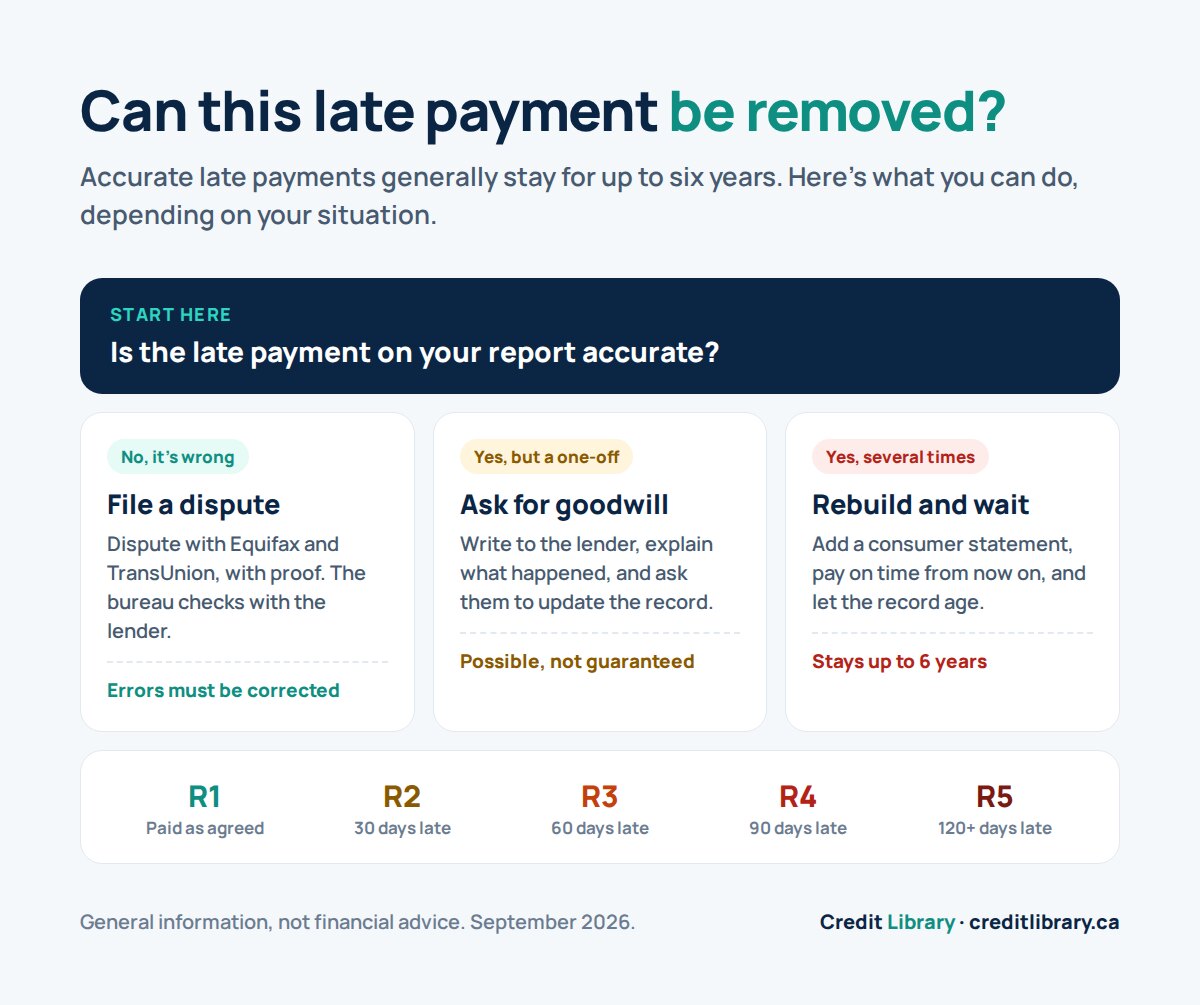
- It’s wrong: you have a right to have inaccurate information corrected. File a dispute.
- It’s accurate, but a one-time slip: ask the lender for a goodwill adjustment. They don’t have to agree, but some do.
- It’s accurate and part of a pattern: it will likely stay. Focus on adding positive history so its impact fades.
Option 1: Dispute late payments that are wrong
Errors happen more often than you’d think: a payment applied to the wrong account, a late mark after you’d arranged a payment deferral, or an account that isn’t even yours. Here’s how to dispute it:
How to dispute a credit report error
Get both reports
Pull your free reports from Equifax and TransUnion. An error may appear on one and not the other. See how to check your credit report for free.
Gather proof
Bank statements showing the payment date, a letter confirming a deferral, or any correspondence with the lender.
File with each bureau
Dispute online, by phone or by mail with TransUnion and Equifax. The bureau will check your claim with the lender.
Contact the lender too
Ask the lender to send a correction to both bureaus. This often speeds things up.
Follow up
Check your reports after the investigation. If the bureau keeps the item, ask for a higher-level review or add a consumer statement.
Option 2: Ask for a goodwill adjustment
If the late payment is accurate but out of character, you can ask your lender to update how it’s reported as a courtesy. This works best when:
- It was a single late payment on an otherwise clean record.
- There was a clear reason, like a job loss, illness, or a bank error during an autopay switch.
- The account is now current and you’ve been a customer for a while.
Call first, then follow up in writing to the lender’s customer relations or credit reporting department. Keep it short, honest and polite. Here’s a simple template:
Hello, I’m writing about my [card/loan] ending in [last four digits]. My [month, year] payment was reported as 30 days late. At the time, [brief reason]. I’ve made every payment on time since then and have been a customer since [year].
I understand the report was accurate, but I’d be grateful if you would consider a goodwill adjustment to update this payment’s status with Equifax and TransUnion. Thank you for considering my request.
Sample goodwill letter
Option 3: Add a consumer statement
If an accurate late payment stays on your report, you can add a short, free consumer statement explaining what happened, for example, a medical emergency or a temporary layoff. It won’t change your score, but lenders who review your full report can see your side of the story.
Beware of credit repair companies
How to recover from a late payment
Even if a late payment stays, its effect on your score gets smaller the older it gets, especially when newer history is positive. To speed things up:
- Set up automatic minimum payments on every account so nothing slips again, then pay more manually.
- Keep your balances low. Your credit utilization is one of the fastest things you can change.
- Don’t close old accounts in good standing. They add length and positive history to your file.
- If you’re struggling to keep up, talk to your lender early. It’s much easier to arrange a plan before a payment goes 30 days late.
Frequently asked questions
How long do late payments stay on your credit report in Canada?
According to Equifax Canada, late payments can stay on your credit report for up to six years from the date they were reported. The impact on your score fades over time, especially if you make every payment on time afterward.
Can a late payment be removed from my credit report?
If it’s an error, yes: the credit bureau must correct inaccurate information after a dispute. If it’s accurate, it generally stays for up to six years, though some lenders may agree to update the record as a goodwill gesture.
Does one 30-day late payment hurt your credit score?
Yes. A payment that’s 30 or more days past due is usually reported to the credit bureaus and can lower your score noticeably, especially if the rest of your history is clean. Payments that are only a few days late usually aren’t reported, though you may still pay a late fee.
Does paying off a collection remove it from my credit report?
No. Paying a collection updates the account to show it’s been paid, which lenders like to see, but the record generally stays on your report for six years from the date of first delinquency.
Can a credit repair company remove late payments?
No one can legally remove accurate, up-to-date information from your credit report. Anything a credit repair company can do, like disputing errors or writing to lenders, you can do yourself for free.
How long does a credit report dispute take in Canada?
Credit bureaus check your claim with the lender that reported it, which often takes about 30 days. Contacting the lender directly at the same time can speed things up.
This article is general information, not legal or financial advice. Credit bureau policies and provincial rules vary; check with Equifax, TransUnion and your lender for your situation. Last reviewed September 2026.