Your wallet has one card, your friend has six, and the internet can’t agree on the right number. So, how many credit cards should you have in Canada? It’s a timely question: Canadians carried $134.2 billion in credit card debt in the second quarter of 2026, according to Equifax Canada, up from $130.6 billion the quarter before.
The right number isn’t about a magic figure. It’s about how each card affects your credit score, your costs and your habits. Here’s how to find your number.
The short answer
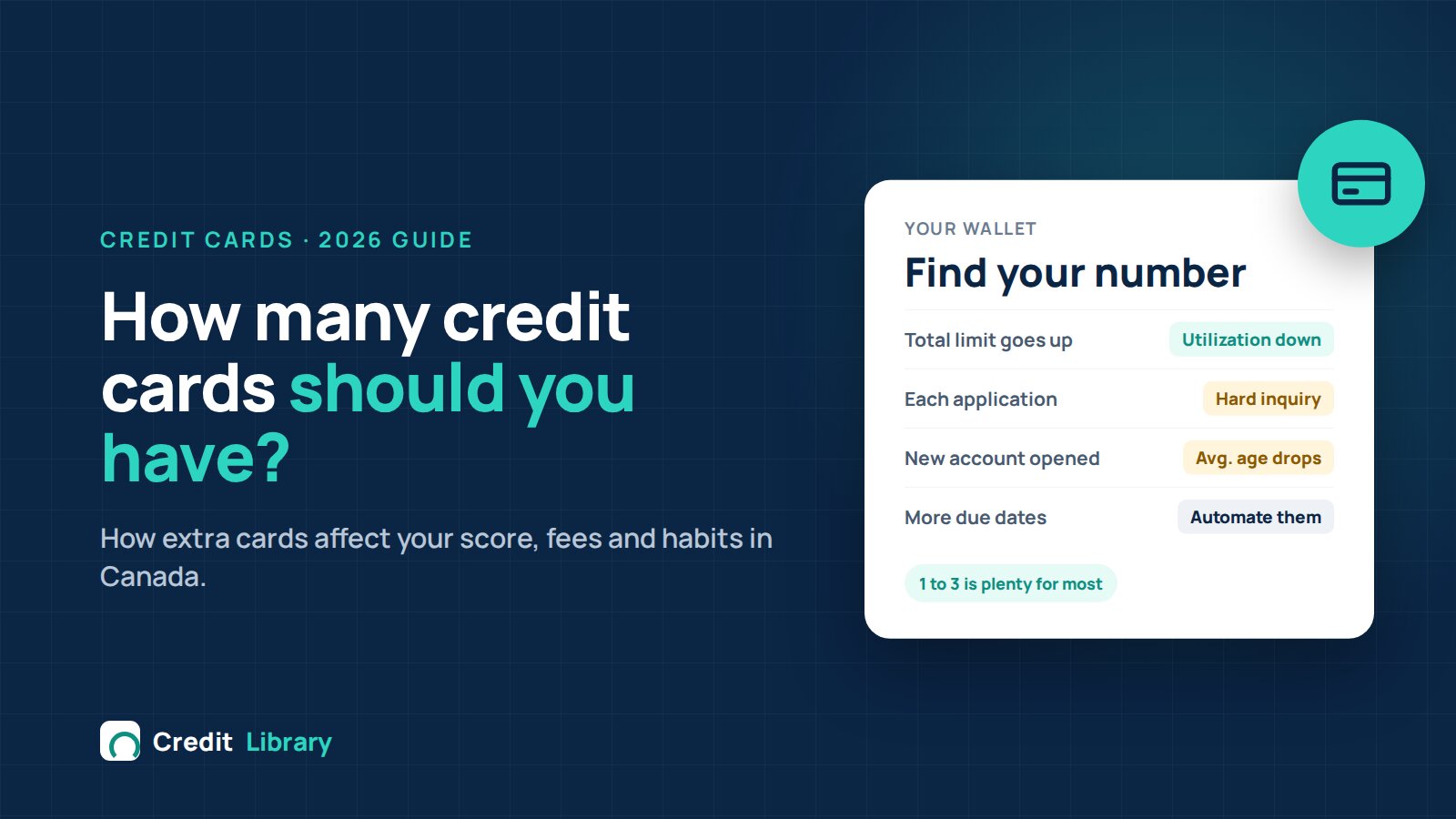
There’s no perfect number. For most Canadians, one to three credit cards is plenty: one main card for everyday spending, plus a backup on a different network in case a card is lost or a store doesn’t take it. More cards can work if you pay every balance in full and track every due date, but they won’t automatically raise your score.
How many credit cards do Canadians have?
Credit cards are nearly universal here. The Bank of Canada’s latest payments survey found 89% of Canadians owned a credit card in 2025. The Canadian Bankers Association counted 76.2 million Visa and Mastercard cards in circulation as of January 2021, roughly two for every person in a country of about 37 million at the 2021 Census, and that’s before counting American Express and store cards.
The last two figures come from Equifax Canada (second quarter of 2026) and the Bank of Canada (2024). The takeaway: most people pay in full, but a large minority carry a balance, and extra cards make that easier to do.
How the number of cards affects your credit score
Owning more cards isn’t directly good or bad for your score. Instead, it changes several of the factors lenders look at:
| Factor | More cards can help | More cards can hurt |
|---|---|---|
| Credit utilization | More total limit lowers your ratio | Only if you don’t add more spending |
| Payment history | More accounts paid on time | More due dates to miss |
| Age of accounts | Old cards kept open add length | Each new card lowers your average age |
| Hard inquiries | None | Each application adds one |
| Credit mix | Cards show revolving credit | Many cards add little variety |
The FCAC recommends using less than 30% of your total credit limit, only applying for credit when you need it, and keeping older accounts open when you can. Hard inquiries may stay on your Equifax report for three years. Learn more in hard vs soft credit checks.
Utilization: where a second card can help
Your utilization is your total balances divided by your total limits. If your spending stays the same, adding a card lowers your ratio. Here’s a simple example with the same $1,500 balance:
Same $1,500 balance, different total limits
The catch: if a new card leads you to spend more, your utilization goes right back up. See how the 30% rule works.
When one, two or three-plus cards make sense
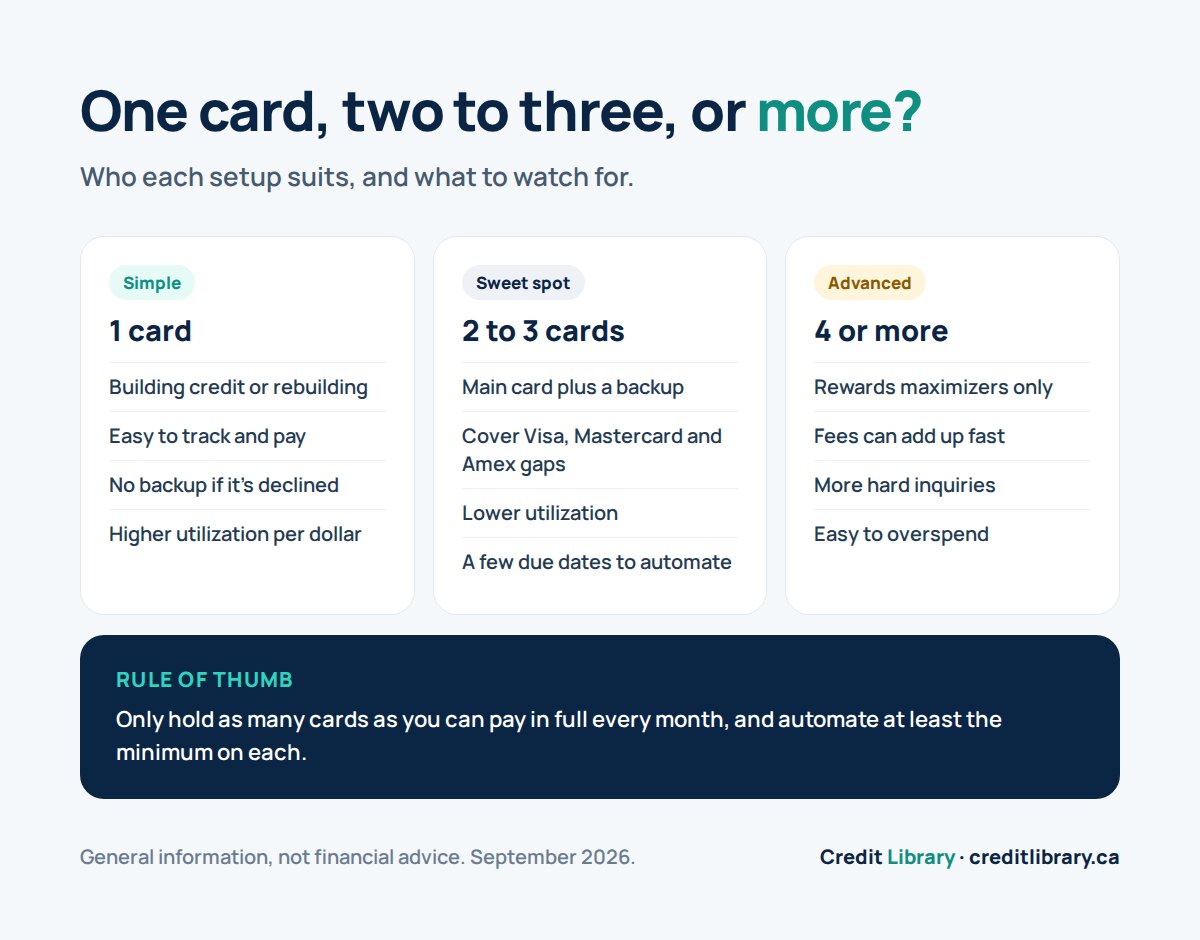
- One card suits people building credit, anyone who has struggled with debt, or anyone who wants to keep things simple. The risk: if it’s lost, frozen for fraud or declined, you have no backup.
- Two or three cards is the sweet spot for many households: a main rewards card, a no-fee backup on a different network, and maybe a card for a specific category like groceries or travel.
- Four or more can make sense for organized people who pay in full and maximize rewards. It’s also where annual fees, missed due dates and overspending become real risks.
Visa, Mastercard and Amex: why network matters
Not every store takes every card. Costco Canada, for example, only accepts Mastercard credit cards in its warehouses and gas stations, takes Visa and Mastercard online, and doesn’t accept American Express anywhere. Some smaller merchants also skip Amex.
If your main card is Amex or Visa, a no-fee card on a different network can fill the gap. That’s a practical reason to have a second card, not just a rewards one.
Annual fees add up
A card with an annual fee needs to earn its keep. Before adding another, total up what you pay in fees across all your cards and compare that with the rewards and perks you actually use. Many people find one premium card plus a no-fee backup covers them. If you already hold a fee card you rarely use, ask your issuer whether you can switch to a no-fee card from the same issuer (a product change), which may keep the account and its history open.
The risks of churning credit cards
“Churning” means opening cards for welcome bonuses, then cancelling or downgrading them. It can pay off for disciplined people, but it comes with trade-offs:
- Hard inquiries pile up, and several in a short time can make lenders see you as riskier right before a mortgage or car loan.
- Your average account age drops each time you open a new card.
- Minimum spend requirements can push you to spend more than you planned.
- Bonus rules often exclude people who’ve held the same card recently. Read the offer terms.
How to manage multiple credit cards
Keep several cards under control
Automate at least the minimum
Set up automatic minimum payments on every card so nothing is ever late, then pay the full balance manually.
Give each card a job
For example, one for groceries and gas, one for subscriptions, one for travel.
Line up your due dates
Many issuers let you change your statement or due date. Ask, so all your payments land near payday.
Keep old no-fee cards active
A small recurring charge, paid in full, helps keep an unused card from being closed for inactivity.
Review once a year
Check fees, rewards and your credit reports, and cut what no longer earns its place.
Thinking of trimming cards instead? Read does closing a credit card hurt your credit first.
Frequently asked questions
How many credit cards should I have in Canada?
There’s no ideal number that fits everyone. For most people, one to three cards is plenty: enough for a backup and for stores that don’t take every network, but few enough to pay in full and on time. The right number is the one you can manage without carrying a balance.
Is it bad to have too many credit cards?
Not by itself. Lots of open cards with low balances can even help your utilization. The risk is behavioural: more cards mean more due dates, more annual fees and more temptation to spend. Each new application also adds a hard inquiry.
How many credit cards does the average Canadian have?
No official average is published, but the Canadian Bankers Association counted 76.2 million Visa and Mastercard cards in circulation in 2021, roughly two per person. The Bank of Canada found 89% of Canadians owned at least one credit card in 2025.
Does opening a new credit card hurt my credit score?
Usually a little, and temporarily. The application triggers a hard inquiry, which can stay on your Equifax report for three years, and a new account lowers the average age of your accounts. Over time, the extra available credit and on-time payments can outweigh the dip.
Should I cancel credit cards I don’t use?
Think before you do. The FCAC notes that closing an account reduces your available credit and can remove older history from your profile. If a no-fee card is one of your oldest, keeping it open with a small recurring charge paid in full is often better.
How long should I wait between credit card applications?
There’s no official rule. The FCAC advises only applying for credit when you need it and avoiding multiple applications at once or too close together. Spacing applications out gives your score time to recover and looks less risky to lenders.
This article is general information, not financial advice. Card terms, fees and acceptance change; check with your issuer and retailers for current details. Last reviewed September 2026.