What credit score do you need for a mortgage in Canada? For an insured mortgage, the official floor is 600. But the score that gets you approved at a good rate is often higher, and the rules around it have shifted a lot in the last two years.
The stakes are high in 2026. The Bank of Canada expects about 60% of outstanding mortgages to renew in 2025 or 2026, and Equifax Canada reports that joint mortgages among first-time buyers rose from 57.6% in 2016 to 70.9% through Q2 2026, a sign of how hard it is to qualify alone. Here’s how your score fits in, from insured mortgages to B-lenders, plus the current stress test and amortization rules.
The short answer
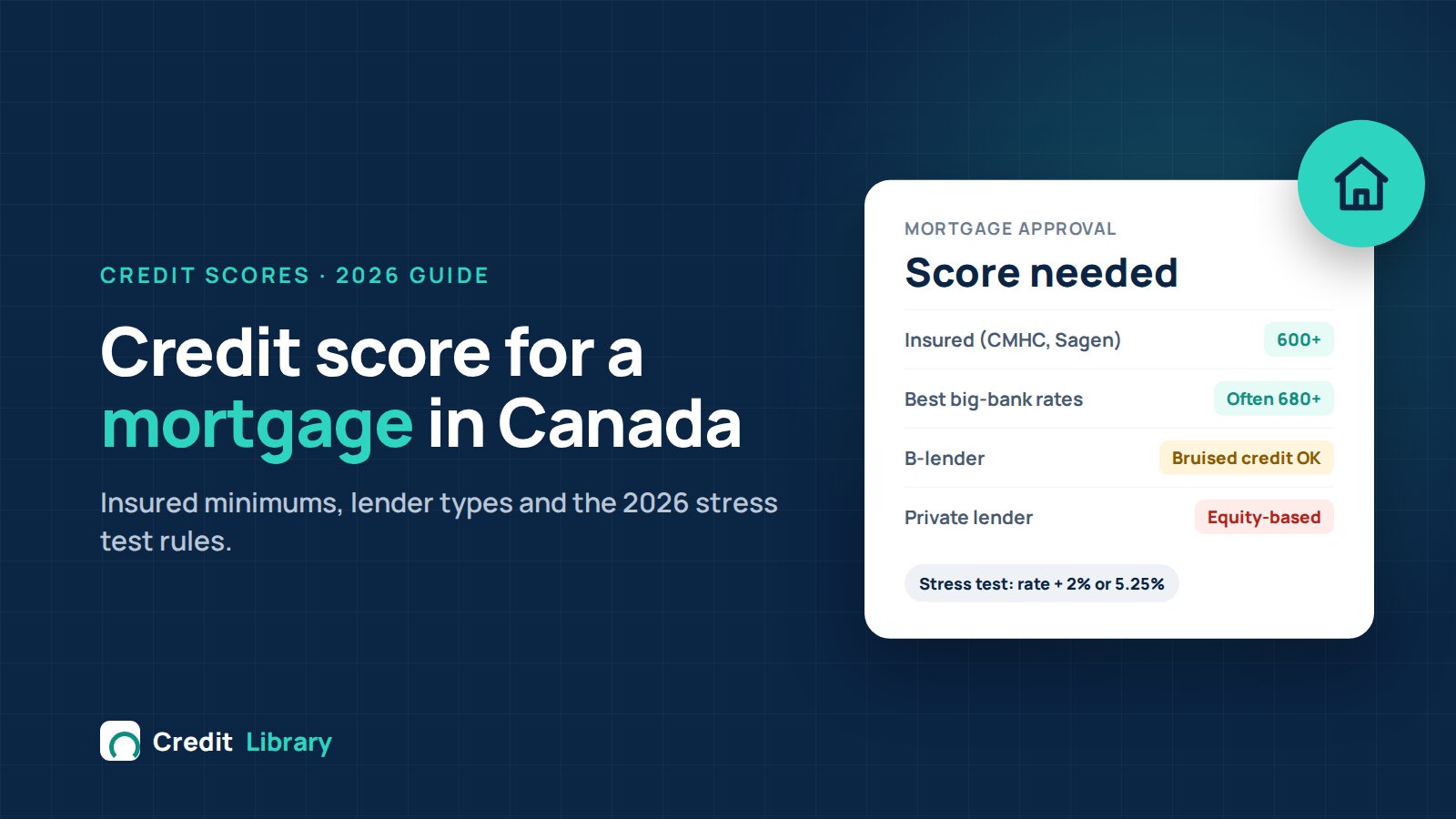
- Insured mortgage (under 20% down): at least one borrower needs a score of 600 or higher under CMHC and Sagen rules.
- Best rates at a big bank: often 680+. Scotiabank, for example, says you’ll need at least 680.
- Below that, or with bruised credit: B-lenders and private lenders may approve you, but rates are typically 1.25% to 2% higher or more, plus fees.
Insured mortgages: CMHC, Sagen and Canada Guaranty
If your down payment is less than 20%, your mortgage must be insured by one of three insurers. Each sets its own credit requirements:
- CMHC: “at least one borrower (or guarantor) must have a minimum credit score of 600,” according to its purchase program rules. It also caps the gross debt service (GDS) ratio at 39% and total debt service (TDS) at 44%.
- Sagen: its Homebuyer 95 program requires at least one applicant with a score of 600 for loans above 80% loan-to-value, and recommends 680 for loans at 80% or less.
- Canada Guaranty: its product listings don’t publish a single minimum score and call for a “strong credit profile” on some programs. Your lender or broker can tell you what applies.
These are floors, not guarantees. Lenders add their own policies on top, and a score just above 600 with recent missed payments may still be declined.
A-lenders vs B-lenders vs private lenders
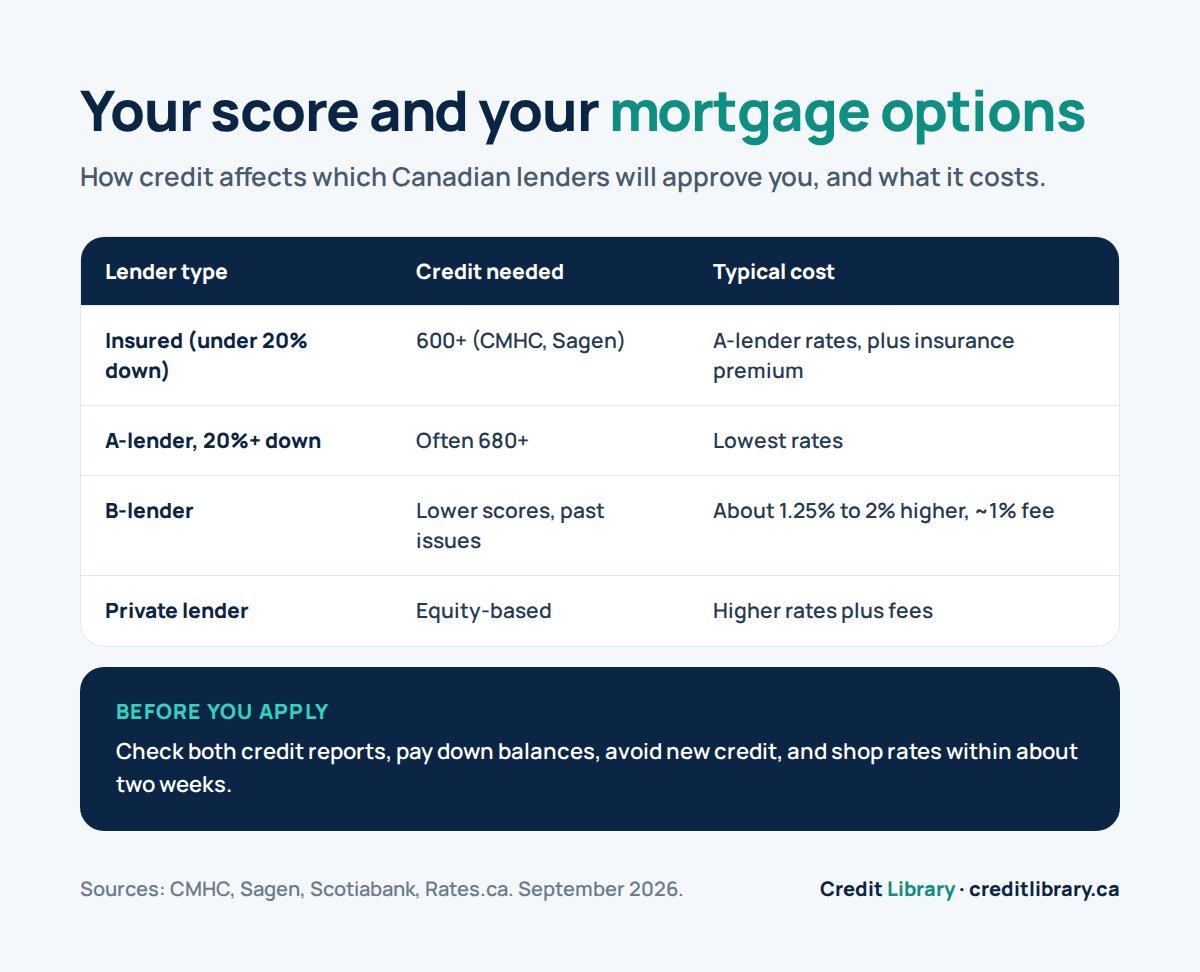
| Lender type | Who it suits | Cost compared with A-lenders |
|---|---|---|
| A-lenders (big banks, many credit unions) | Good credit and provable income | Lowest rates |
| B-lenders (alternative lenders, trust companies) | Lower scores, past credit problems, harder-to-prove income | Rates about 1.25% to 2% higher, often around 1% in fees |
| Private lenders | Short-term needs, serious credit issues, equity-based loans | One comparison site cites 7% to 8% on first mortgages, plus lender and broker fees |
B-lender and private mortgages are usually meant as a bridge. Rates.ca notes B-lender terms are typically one to three years, giving you time to rebuild credit and move back to an A-lender at renewal.
How your credit score affects your mortgage rate
Scotiabank calls your credit score one of the key factors in setting your interest rate. The bigger jump usually comes from which type of lender will approve you. Moving from an A-lender to a B-lender can add over a full percentage point, which on a large mortgage can mean thousands of dollars a year.
Your score also matters for approval itself. The FCAC warns that with a weak credit history, a lender may refuse your mortgage or require a co-signer.
The mortgage stress test in 2026
To get a mortgage from a federally regulated lender, you must qualify at a rate higher than the one you’ll actually pay. For uninsured mortgages, OSFI sets the minimum qualifying rate at the greater of your contract rate plus 2% or 5.25%. The FCAC describes the same test for mortgages from federally regulated banks. OSFI reviews the rate at least annually, and in early 2026 its superintendent indicated the stress test is staying.
The renewal change: since November 21, 2024, OSFI no longer requires the stress test for uninsured straight switches, meaning you move your mortgage to another federally regulated lender at renewal without increasing the loan amount or amortization (up to $3,000 in transaction costs can be added). Insured borrowers switching lenders already didn’t have to requalify. The new lender will still review your application, and it’s still expected to follow sound underwriting.
30-year amortizations for first-time buyers and new builds
Since December 15, 2024, insured mortgages can have 30-year amortizations for all first-time home buyers and for all buyers of new builds. The maximum price for an insured mortgage also rose to $1.5 million. Sagen confirms amortizations beyond 25 years require first-time buyer status or a new construction purchase. A longer amortization lowers your payment, which can help your debt ratios, but you’ll pay more interest over time.
After a consumer proposal or bankruptcy
How long it stays: according to Equifax, a consumer proposal is removed three years after you’ve paid it off, or six years from filing, whichever comes first. A first bankruptcy stays for six years after discharge.
Qualifying again is possible. Licensed Insolvency Trustee Spergel says prime insured lenders typically want you discharged from bankruptcy for at least two years, with at least a year of re-established credit on two accounts. B-lenders may consider you sooner, and private lenders sometimes immediately, at a higher cost. Requirements vary, so ask a mortgage professional. Learn more in Consumer Proposal vs Bankruptcy in Canada.
How to improve your credit before you apply
Six steps in the months before a mortgage application
Check both reports
Get your free Equifax and TransUnion reports. Lenders may use either. See how to check your credit report for free.
Fix errors
Dispute mistakes like late payments you didn’t make. Here’s how to remove late payments that are wrong.
Pay every bill on time
Payment history is key. The FCAC suggests at least the minimum if you can’t pay in full.
Lower your balances
Try to use less than 30% of your total credit limit, as the FCAC recommends. Lower debt also improves your TDS ratio. More on credit utilization.
Pause new credit
Avoid new cards, car loans or buy now, pay later plans before applying. New debt and hard inquiries can work against you.
Shop rates in a short window
Compare lenders within about two weeks so it counts as one inquiry. See hard vs soft credit checks.
Frequently asked questions
What is the minimum credit score for a mortgage in Canada?
For an insured mortgage (less than 20% down), CMHC requires at least one borrower or guarantor to have a credit score of 600 or higher. Individual lenders can set higher minimums, and many look for 680 or more for their best rates. B-lenders and private lenders may approve lower scores at higher cost.
Can I get a mortgage with a 600 credit score in Canada?
Possibly. A 600 score meets the minimum for CMHC and Sagen insured mortgages, but lenders also look at your income, debts, down payment and payment history. Expect fewer options than with a higher score, and compare offers from a few lenders or a mortgage broker.
Do mortgage lenders use Equifax or TransUnion?
It depends on the lender. Some pull from Equifax, some use TransUnion, and some check both. Your scores can differ between bureaus, so check both reports before you apply.
Does getting pre-approved for a mortgage hurt your credit?
A pre-approval is often a hard inquiry, which can cause a small, temporary dip. Some lenders use a soft check for online pre-approvals. If you shop with several lenders within about two weeks, the credit bureaus generally treat it as one inquiry.
Do I have to pass the stress test when I renew my mortgage?
Not if you renew with your current lender. Since November 21, 2024, uninsured borrowers who switch to another federally regulated lender at renewal also don’t face the stress test, as long as they don’t increase the loan amount or amortization. Insured borrowers switching lenders already didn’t have to requalify.
How soon after a consumer proposal can I get a mortgage?
It varies. Some B-lenders and private lenders will consider you sooner, while prime lenders often want to see time since completion plus rebuilt credit. For bankruptcy, a Licensed Insolvency Trustee notes prime insured lenders typically want at least two years since discharge. Talk to a mortgage professional about your file.
This article is general information, not financial or mortgage advice. Lender, insurer and provincial rules vary and can change; check with a lender or licensed mortgage professional for your situation. Last reviewed September 2026.