Canadians owe more than ever. Equifax Canada reports that total consumer debt reached $2.68 trillion in Q2 2026, up 4.18% from a year earlier, and credit card debt alone hit $134.2 billion. In an Equifax survey from July 2026, one in four Canadians said they expect to make only minimum credit card payments. If you want out faster, the classic question is debt avalanche vs snowball: which payoff method is better?
Both work. They just order your debts differently. Below, we run the numbers on a realistic Canadian example so you can see exactly how much time and interest each method costs, and which one fits you.
The short answer
- Debt avalanche: pay minimums on everything, then put every extra dollar on the debt with the highest interest rate. It saves the most money.
- Debt snowball: pay minimums on everything, then attack the smallest balance first. You get quicker wins, which can keep you motivated.
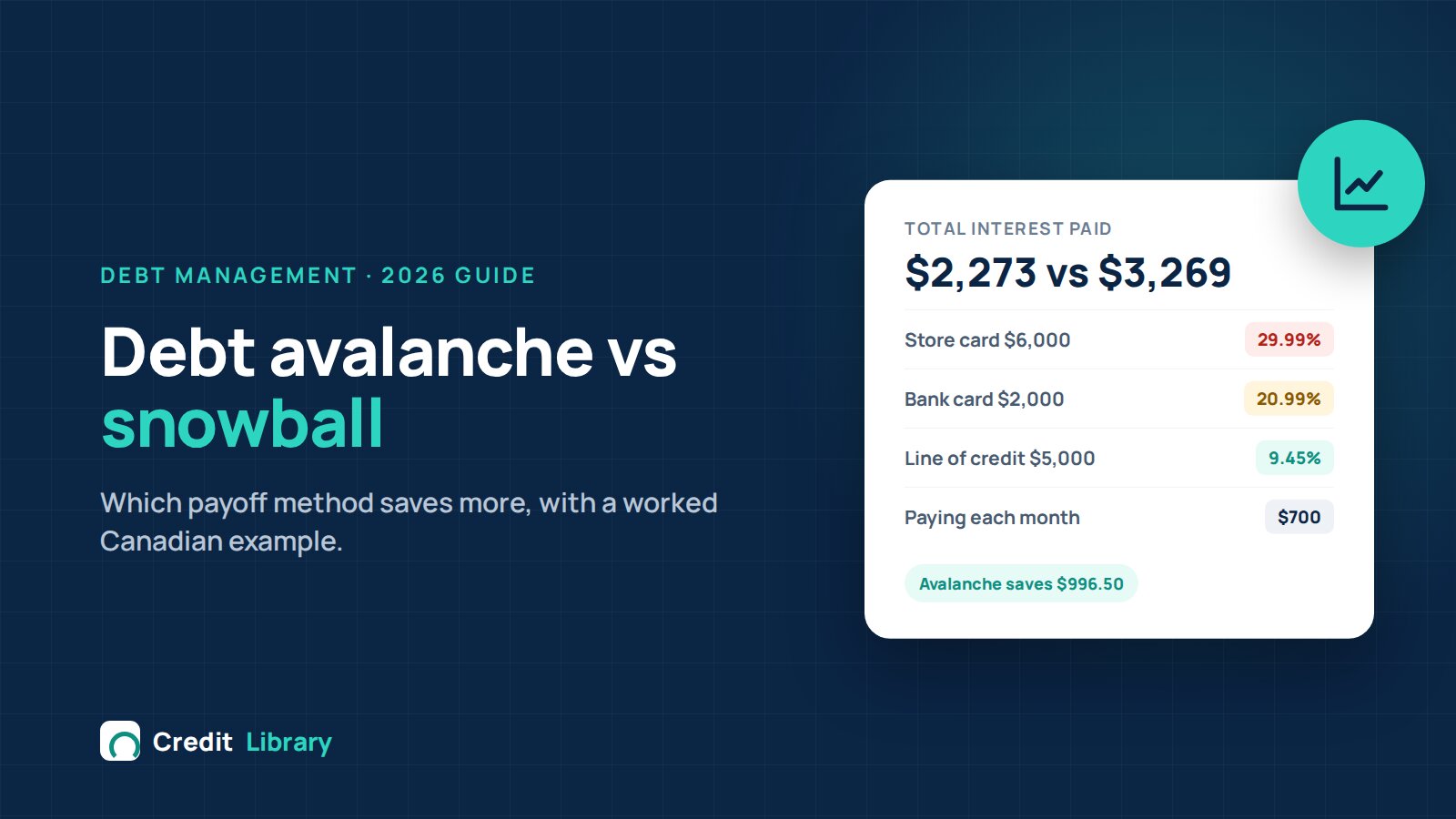
- In our example, the avalanche saved $996.50 and two months. The snowball cleared its first debt eight months sooner.
How the debt avalanche works
List your debts from highest interest rate to lowest. Make the minimum payment on all of them, then send any extra money to the top of the list. When that debt is gone, roll its whole payment into the next one. Because you’re shrinking your most expensive balance first, you pay less interest overall. That’s why economists at the Federal Reserve Bank of St. Louis point to it as the lowest-cost approach.
How the debt snowball works
List your debts from smallest balance to largest, ignoring interest rates. Pay minimums on all of them and throw everything extra at the smallest. Each payoff frees up a payment that rolls into the next debt, so the amount you’re paying grows like a snowball. Research published in the Harvard Business Review found that focusing on paying off smaller balances first can boost people’s sense of progress, which helps them keep going.
A worked Canadian example
Let’s say you have three debts at typical Canadian rates. The standard purchase rate on most credit cards is 19.99% or 20.99%, store cards often charge 24.99% to 29.99%, and with the prime rate at 4.45% after the Bank of Canada held its policy rate at 2.25% in September 2026, an unsecured line of credit at prime plus 5% would be 9.45%.
| Debt | Balance | Interest rate | Minimum payment |
|---|---|---|---|
| Store credit card | $6,000 | 29.99% | $180 |
| Bank credit card | $2,000 | 20.99% | $60 |
| Line of credit | $5,000 | 9.45% | $100 |
| Total | $13,000 | $340 |
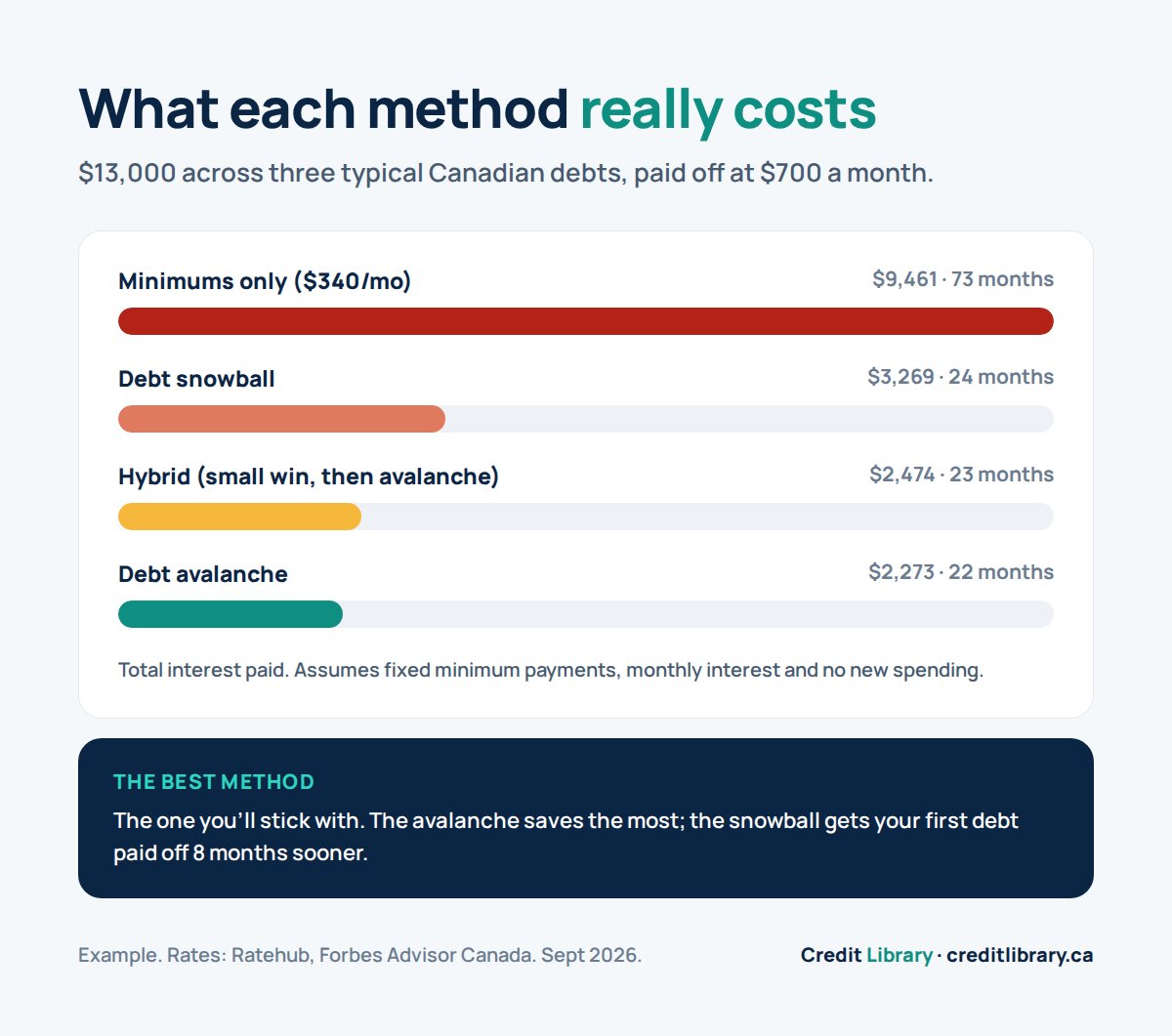
You can afford $700 a month in total, so you have $360 extra on top of the minimums. We ran each method month by month with a small script (interest charged monthly, minimum payments held fixed for simplicity). Here’s the result:
Total interest paid on $13,000 of debt
And here’s when each debt disappears:
| Debt paid off | Avalanche | Snowball |
|---|---|---|
| Store card ($6,000, 29.99%) | Month 14 | Month 24 |
| Bank card ($2,000, 20.99%) | Month 16 | Month 6 |
| Line of credit ($5,000, 9.45%) | Month 22 | Month 15 |
| Total interest | $2,272.85 | $3,269.35 |
The avalanche wins on cost by $996.50, mostly because the snowball leaves the 29.99% store card growing until the very end. But the snowball gives you your first win in month 6, while avalanche users wait until month 14. Either way, both beat minimum payments by more than $6,000 in interest and about four years.
When each method wins
Choose the avalanche if:
- Your interest rates are far apart, like a store card near 30% and a line of credit under 10%.
- Your highest-rate debt is also a big balance. That’s where the savings grow.
- You’re motivated by numbers and can stay the course without quick wins.
Choose the snowball if:
- You’ve started debt plans before and given up.
- You have several small balances you could clear within a few months.
- Your rates are similar. When rates are close, the two methods cost about the same, so you lose little by chasing quick wins.
The hybrid approach
You don’t have to pick a side. A popular middle path: knock out one small balance first for a quick win, then switch to the avalanche. In our example, paying off the $2,000 card first and then the 29.99% store card cost $2,474.14 over 23 months. That’s only $201.29 more than the pure avalanche, and it still gets you a win in month 6.
How to start either method
Your debt payoff plan in five steps
List every debt
Write down each balance, interest rate and minimum payment. Check your statements or your credit report so nothing is missed.
Set your monthly budget
Decide how much you can pay in total each month. Even $50 above the minimums makes a difference.
Pay every minimum, automatically
Set up automatic minimum payments on all accounts. The FCAC stresses paying on time, and a missed payment hurts your score.
Target one debt
Send all extra money to the highest rate (avalanche) or smallest balance (snowball).
Roll it over
When a debt is paid off, add its full payment to the next target. Don’t let that money drift back into spending.
How paying off debt affects your credit score
Both methods protect your payment history, since you pay at least the minimum on everything. As card balances fall, your credit utilization drops too. The FCAC suggests using less than 30% of your total credit limit. Learn more about how credit utilization works.
Once a card is paid off, think twice before closing it. The FCAC notes that closing accounts can reduce your available credit and shorten your credit history, which can lower your score.
If high rates are the main problem, a lower-rate consolidation loan or balance transfer may help alongside either method. Compare options in Debt Consolidation in Canada, and see why minimum payments keep you in debt so long.
Frequently asked questions
Is the debt avalanche or snowball better?
The avalanche method saves the most money because you pay off the highest-interest debt first. The snowball method pays off the smallest balance first, which gives quicker wins and can help you stay motivated. The better choice is the one you’ll stick with until every debt is gone.
How much can the debt avalanche save?
It depends on your balances, rates and how much extra you can pay. In our example with $13,000 of debt and $700 a month, the avalanche saved $996.50 in interest and finished two months sooner than the snowball.
Does the debt snowball hurt your credit score?
No. Both methods have you pay at least the minimum on every debt, which protects your payment history. Paying down credit card balances also lowers your credit utilization, which can help your score.
Should I pay off my credit cards or line of credit first?
With the avalanche method, you pay the highest interest rate first, which in Canada is usually a credit card or store card rather than a line of credit. Always keep making the minimum payment on every account.
Should I close my credit cards after paying them off?
Often it’s better not to. The Financial Consumer Agency of Canada notes that closing accounts can reduce your available credit and shorten your credit history. If a card has an annual fee or tempts you to spend, weigh that against the credit impact.
What if I can’t afford more than the minimum payments?
Start by trimming expenses or adding income, even a small amount, and put it toward one debt. If that isn’t enough, look at debt consolidation or talk to a non-profit credit counsellor before you fall behind.
This article is general information, not financial advice. The example is illustrative; your results depend on your balances, rates and lender terms. If you’re struggling with debt, consider speaking with a non-profit credit counsellor. Last reviewed September 2026.