Shopping for a vehicle this fall? Before you fall for a sticker price, it pays to know the number lenders look at first. So, what credit score do you need for a car loan in Canada? There’s no single cut-off, but your credit score has a big say in whether you’re approved and what interest rate you’ll pay.
Canadians are being cautious. Equifax Canada reports that the number of new auto loans opened in the second quarter of 2026 was 9.2% lower than a year earlier, even as the average new loan grew to $36,979. With that much money on the line, a few points on your score can mean thousands of dollars over the life of a loan.
The short answer
Most lenders don’t publish a minimum score. As a rough guide, scores of about 660 and up can usually qualify fairly easily for mainstream dealer or bank financing, and scores above 760 tend to get the lowest rates and most flexible terms. Below about 600, you can still get financed, but often through subprime lenders, with a bigger down payment, a co-signer or a much higher rate. Exact cut-offs vary by lender.
Car loan rates by credit score
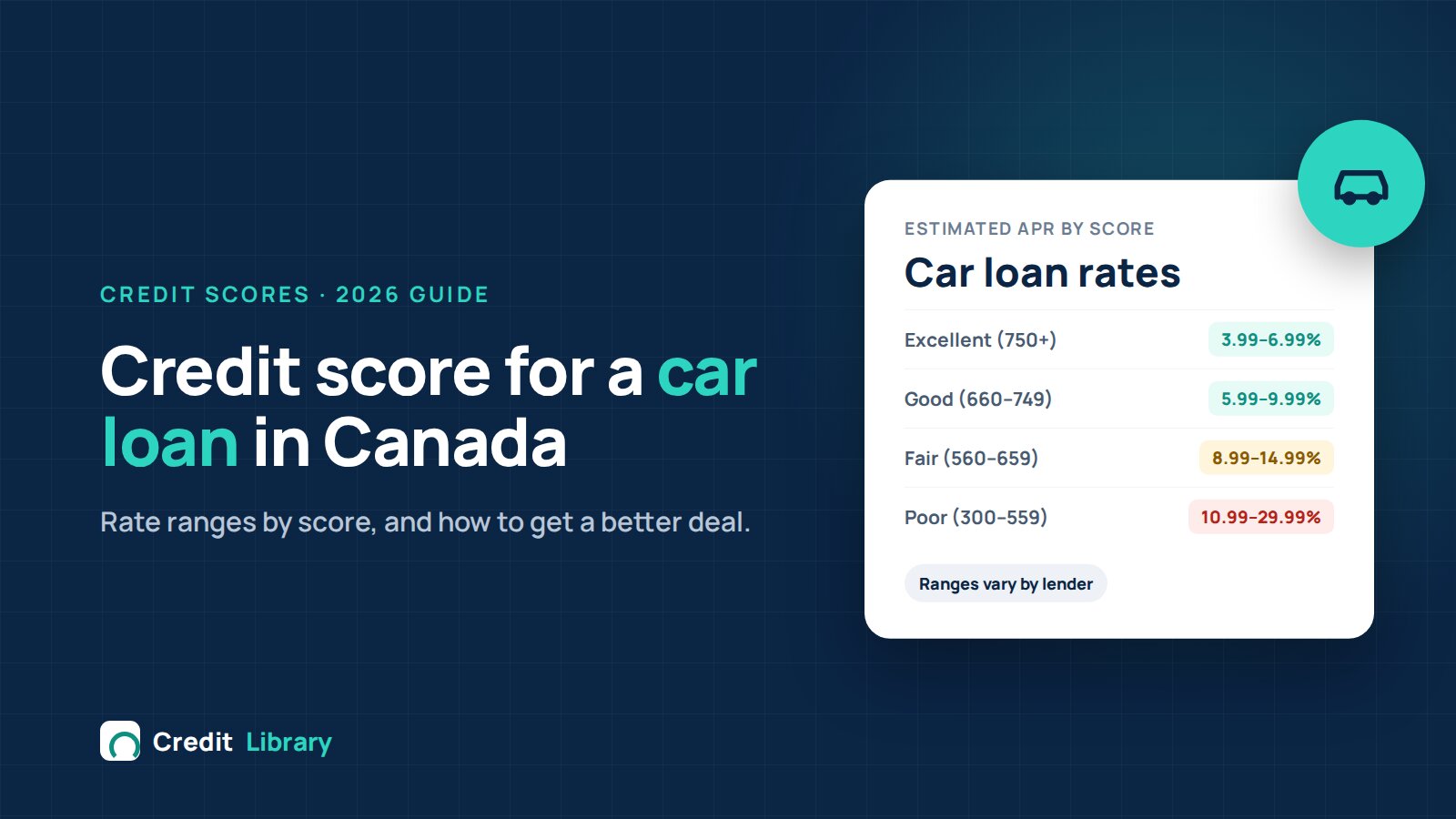
Lenders price risk, so the lower your score, the higher your rate. Rate-comparison site WOWA.ca publishes these estimated APR ranges by credit score for Canadian car loans:
| Credit score | Tier | Estimated APR range |
|---|---|---|
| 750 and up | Excellent | 3.99% to 6.99% |
| 660 to 749 | Good | 5.99% to 9.99% |
| 560 to 659 | Fair | 8.99% to 14.99% |
| 300 to 559 | Poor | 10.99% to 29.99% |
Treat these as ballpark figures, not quotes. Every lender uses its own score bands, and your rate also depends on your income, existing debts, job stability, down payment, the loan term and whether the vehicle is new or used. Not sure where you stand? Here’s what counts as a good credit score in Canada.
Car loans in 2026: what the data shows
The figures above come from Equifax Canada’s Q2 2026 data, which also shows the 90+ day delinquency rate on auto loans edged down to 1.10%. Earlier in the year, Equifax noted that new captive auto loans (financing through a carmaker’s own lender) fell to a three-year low, pointing to rising insurance, maintenance and fuel costs as reasons Canadians are holding off.
Dealer vs bank vs credit union financing
According to the Financial Consumer Agency of Canada (FCAC), most dealerships arrange your loan for you with a lender, such as a manufacturer’s finance company, a bank, a credit union or an independent finance company. You can also go straight to your own bank or credit union for a car loan or line of credit.
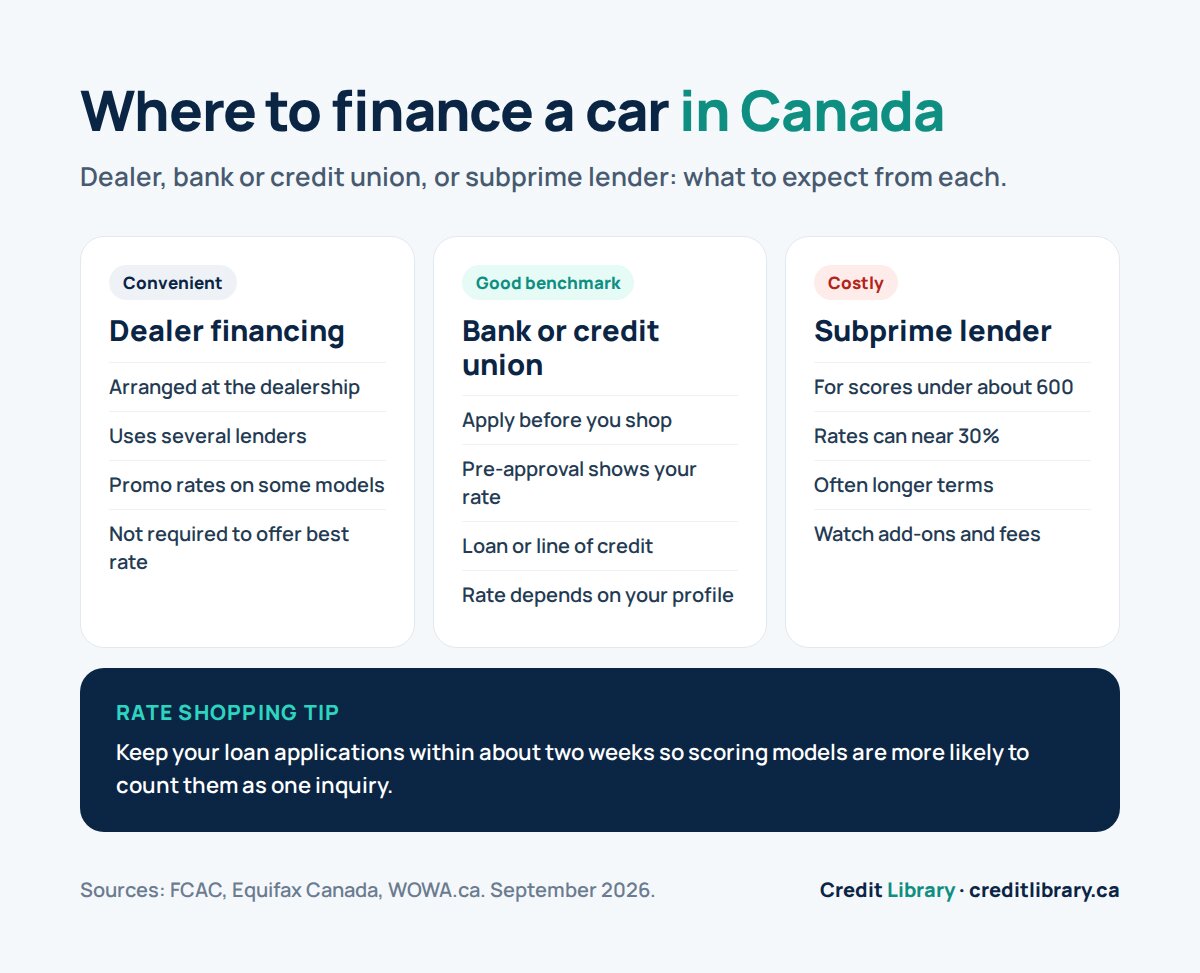
The FCAC also points out that dealers aren’t obligated to offer you their best rate, so shop around and negotiate. Manufacturer promotions can offer very low rates, but usually only on specific models and to buyers with strong credit. A pre-approval from your bank or credit union gives you a benchmark to bring to the dealership.
Subprime car loans and their risks
If your score is below about 600, or you’re new to credit, you may be offered a subprime loan. These can help you get a vehicle and rebuild credit with on-time payments, but they’re expensive. Rates at the high end can approach 30%. Canada’s criminal interest rate has been capped at 35% APR since January 1, 2025, so a lender can’t legally charge more than that, but a legal rate can still be a very costly one.
Long loan terms and negative equity
To keep payments manageable, loan terms have stretched to six to eight years, according to an auto credit executive quoted by Canadian Auto Dealer in July 2026. That’s 72 to 96 months. A longer term lowers your payment but raises your total cost. The FCAC’s own example shows the difference on a $25,000 car at 5% interest:
| Loan term | Total interest paid |
|---|---|
| 36 months (3 years) | $1,974 |
| 84 months (7 years) | $4,681 |
Long terms also raise the risk of negative equity, which the FCAC defines as owing more on your loan than your car is worth. Cars lose value fast: most vehicles lose 15% to 25% of their value in the first year, according to Canadian Black Book data. If you trade in while underwater, the shortfall is often rolled into your next loan, so you start deeper in debt.
How to shop for a car loan without hurting your credit
Every lender that pulls your credit adds a hard inquiry, which can stay on your report for up to 36 months. The good news: Equifax Canada says many scoring models count multiple inquiries for the same kind of loan within a short window as one. That window ranges from 14 to 45 days depending on the model, and it doesn’t apply to credit cards. Learn more about hard vs soft credit checks.
Shopping for a car loan, step by step
Check your credit first
Pull your free reports from Equifax and TransUnion and fix any errors. See how to check your credit report for free.
Set a total budget
Include insurance, fuel and maintenance, not just the monthly payment.
Get a pre-approval
Ask your bank or credit union what rate and amount they’ll offer.
Compare within two weeks
Keep dealer and lender applications close together so inquiries are more likely to count as one.
Compare the total cost
Look at the APR, term, fees and add-ons, then choose the shortest term you can afford.
Down payments and co-signers
Most car loans don’t require a set down payment, but putting money down shrinks your loan, lowers the interest you pay and gives you a cushion against negative equity. If your credit is fair or poor, a lender may ask for one before approving you.
A co-signer with stronger credit can also help you qualify or get a better rate. Just know what you’re asking: a co-signer is equally responsible for repaying the loan, and any missed payments can show up on their credit report too.
Frequently asked questions
What is the minimum credit score for a car loan in Canada?
There’s no official minimum. Lenders set their own cut-offs, and many mainstream lenders approve scores around 660 and up fairly easily. Below about 600, financing is still possible, but usually through subprime lenders, often with a larger down payment, a co-signer or a much higher rate.
Can I get a car loan with a 600 credit score in Canada?
Often, yes, but expect a higher rate than someone with good credit and closer checks on your income, job and down payment. Compare offers from your bank or credit union with dealer financing before you sign.
Does shopping for a car loan hurt my credit score?
Each lender that pulls your credit adds a hard inquiry. According to Equifax Canada, many scoring models treat multiple inquiries for the same type of loan within a short window, from 14 to 45 days depending on the model, as one. Keep your rate shopping in a tight time frame.
Is it better to finance through the dealer or my bank?
Neither is always cheaper. Dealers can arrange loans with manufacturer finance arms, banks, credit unions and finance companies, and sometimes offer promotional rates on specific models. Getting a pre-approval from your own bank or credit union first gives you a rate to compare against.
Is an 84-month car loan a bad idea?
Not always, but it costs more. A longer term lowers the payment while increasing the total interest you pay, and it raises the chance you’ll owe more than the car is worth for years. Choose the shortest term whose payment you can comfortably afford.
How much should I put down on a car in Canada?
There’s no required amount for most loans, but a bigger down payment means a smaller loan, less interest and less risk of negative equity. If your credit is weak, some lenders may require one before they approve you.
This article is general information, not financial advice. Rates, score requirements and loan terms vary by lender and change often; check current offers with lenders directly. Last reviewed September 2026.