A letter or call from a collection agency is stressful, especially if you weren’t expecting it. If you have debt in collections in Canada, you probably want to know three things: what it does to your credit, what collectors are allowed to do, and how long they can pursue you. You’re not alone: in the second quarter of 2026, Equifax Canada reported a 90-plus-day credit card delinquency rate of 4.19%.
This guide explains how debts end up in collections, how long they stay on your credit report, your rights under provincial law, time limits by province, and how to settle safely without getting scammed.
The short answer
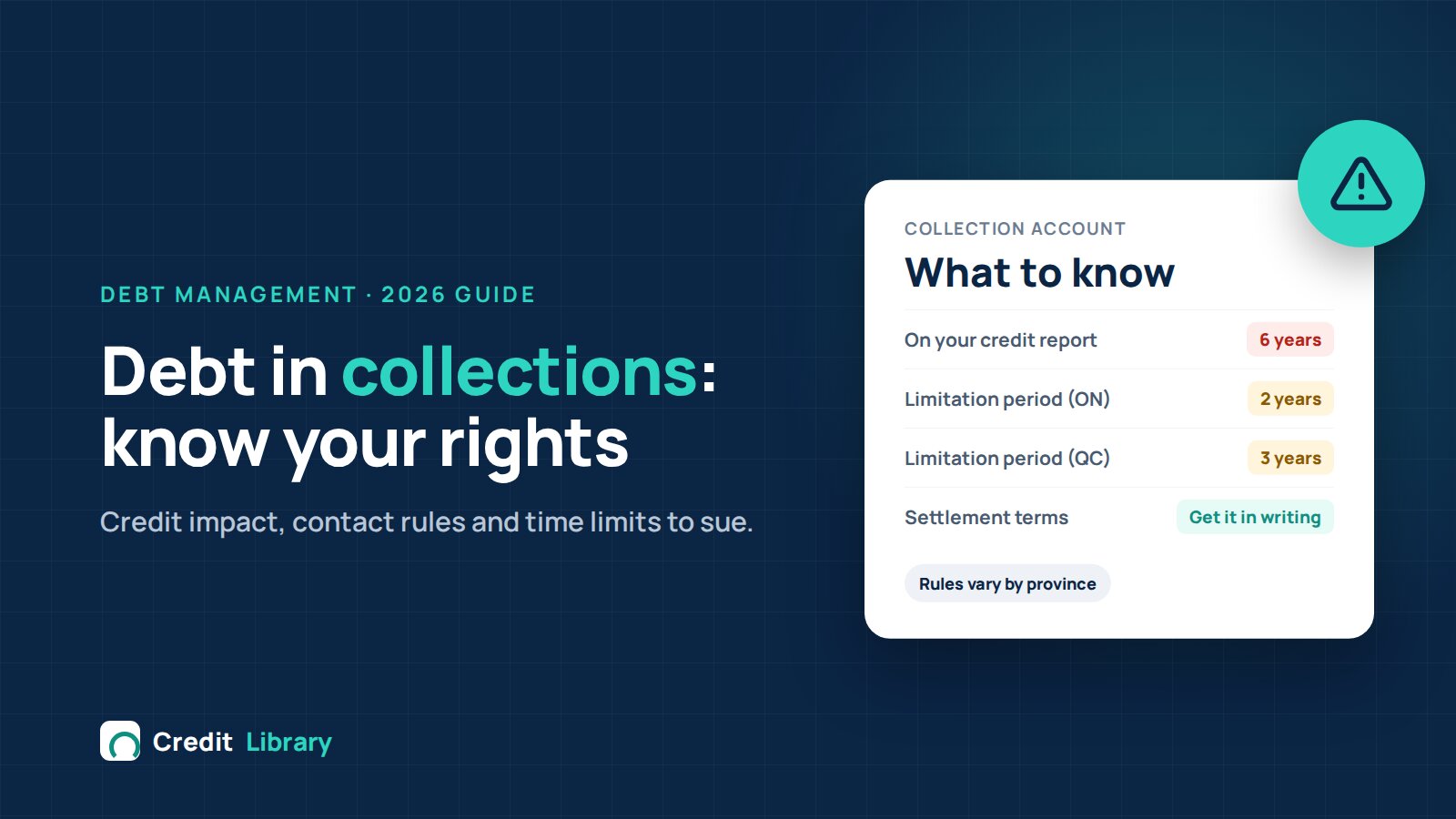
When you stop paying a debt, the lender may collect it itself, hire a collection agency, or sell it. A collection account usually stays on your Canadian credit report for six years from the date of first delinquency, even after you pay it. Collectors must follow provincial rules on when and how they contact you, and in most provinces lenders have a limited time, often two years, to sue.
How a debt goes to collections
After several missed payments, your lender will usually try to collect the debt through its own department first. If that doesn’t work, the FCAC explains that it may hire a collection agency or sell your debt to one. You’ll typically get written notice before collection starts, including the agency’s name, the creditor’s name and the amount owed.
How collections affect your credit report
The FCAC is blunt: once a debt is sent to collections, your credit score will go down. That can affect loan approvals and the rates you’re offered.
| Credit bureau | How long a collection stays |
|---|---|
| Equifax Canada | 6 years from the date of first delinquency |
| TransUnion Canada | 6 years after the date you defaulted |
Sources: Equifax Canada and TransUnion Canada. Paying a collection updates its status to paid, but it doesn’t remove it early. If a collection is listed incorrectly, for example it isn’t yours or the date is wrong, you can dispute it. Here’s how to check your credit report for free.
Your rights when a collector contacts you
Collection agencies are licensed and regulated by the provinces, so your rights depend on where you live. Here are two examples.
Ontario
Under Ontario’s Collection and Debt Settlement Services Act, according to the Government of Ontario:
- The agency must first send you a letter by mail or email with the debt details, the amount owed, the original creditor and a statement of your rights, then wait six days before contacting you to collect.
- It can’t call between 9 p.m. and 7 a.m., on Sundays except between 1 p.m. and 5 p.m., or on statutory holidays.
- After first contact, it can’t contact you more than three times in seven days without your consent.
- It can contact your employer once, to confirm your employment, business title or business address. Wider contact generally needs your permission, or applies only if your employer guaranteed the debt.
- It can’t harass you or use threatening, profane or intimidating language.
- If you dispute the debt by verifiable means, like registered mail or email, and suggest the matter be taken to court, it must stop contacting you without your consent.
British Columbia
In B.C., Consumer Protection BC says collectors can contact you between 7 a.m. and 9 p.m. Monday to Saturday and between 1 p.m. and 5 p.m. on Sunday, but not on statutory holidays. B.C. doesn’t set a weekly limit on contacts, but collectors can’t threaten legal action they aren’t taking or discuss your debt with others without permission. You can ask them to communicate only in writing or through your lawyer.
Time limits: how long can a collector sue you?
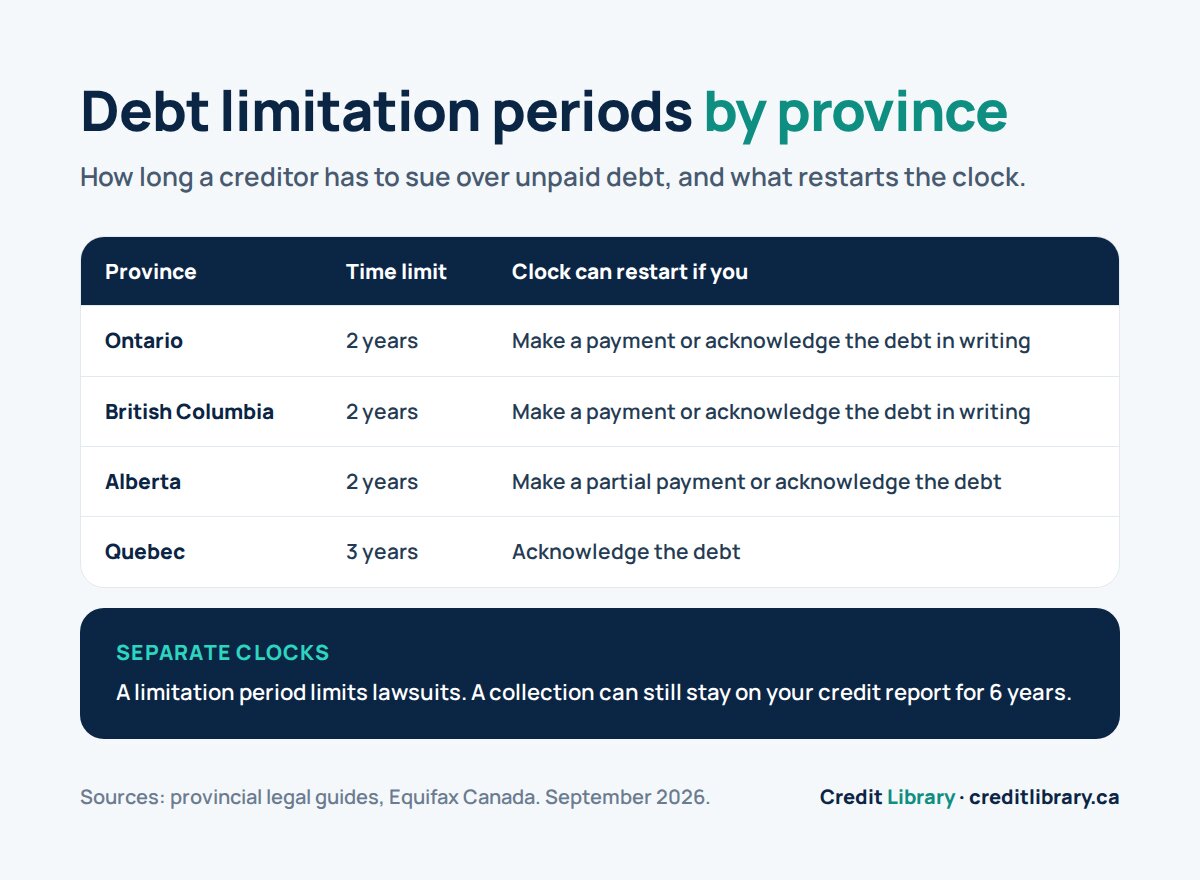
A limitation period is the time a creditor has to start a lawsuit to collect a debt. It’s separate from how long the debt shows on your credit report. Here’s what applies in four provinces:
| Province | Limitation period | What can restart the clock |
|---|---|---|
| Ontario | 2 years | A payment or a written acknowledgement of the debt |
| British Columbia | 2 years | A payment or a written acknowledgement of the debt |
| Alberta | 2 years | Acknowledging the debt or making a partial payment |
| Quebec | 3 years | Acknowledging the debt, or the creditor filing a lawsuit |
A few important points:
- The debt doesn’t disappear. After the limitation period, collectors can often still call and ask you to pay. The difference is that you may have a defence if they sue.
- Small actions can restart the clock. In several provinces, even a small payment or a written promise to pay can reset the limitation period.
- Your credit report runs on its own clock. A collection can stay for six years whatever the limitation period.
How to verify and deal with a collection
What to do when a collector contacts you
Get the details in writing
Ask for the agency’s name, the original creditor, the account number and the amount owed, including how it was calculated.
Check your own records
Compare it with your bills and bank statements, and pull your Equifax and TransUnion reports to see how it’s listed.
Dispute anything wrong
If the debt isn’t yours, is already paid, or the amount is off, dispute it in writing with the agency and with the credit bureaus.
Negotiate in writing
If you owe it, ask about a payment plan or a settlement. Get the full agreement in writing before you send money.
Keep proof
Pay in a traceable way, keep receipts, and check your credit reports afterward to confirm the account is updated.
Settled vs paid in full: what shows on your report
If you pay the full balance, the collection shows as paid. If you negotiate a settlement for less than you owe, it can show as settled, which tells future lenders you didn’t repay the whole debt. According to Borrowell, settling generally has more of a negative impact than paying in full, though either one is usually better than leaving the debt unpaid.
Whichever you choose, make sure the written agreement states the amount that will fully resolve the debt and how it will be reported. Once you pay, check both credit reports and dispute the entry if it isn’t updated.
Watch out for collection scams
Scammers pose as collection agencies, and even as the Canada Revenue Agency. The CRA says it will never threaten to arrest you or demand payment by gift cards or cryptocurrency. Real collectors don’t either.
- Don’t pay a debt you don’t recognize until you’ve verified it in writing.
- Look up the agency yourself and call the number you find, not the one in a text or voicemail.
- Report scams to the Canadian Anti-Fraud Centre.
When to get help
If you have several debts in collections, a non-profit credit counsellor can help you understand your options. For larger debts, a Licensed Insolvency Trustee can explain whether a consumer proposal or bankruptcy makes sense, which can stop collection calls. Once the collections are dealt with, here’s how to raise your credit score.
Frequently asked questions
How long does a collection stay on your credit report in Canada?
According to Equifax Canada, a collection account is removed six years from the date of first delinquency. TransUnion says collection accounts are removed six years after the date you defaulted. Paying the debt updates its status but doesn’t restart or shorten that clock.
Does paying a collection improve my credit score?
Paying a collection updates the account to show it’s paid, which lenders prefer to see, but the record generally stays on your report for six years. Paying can also stop further collection activity. Your score recovers more as the entry ages and you add positive history.
Can a collection agency still collect after the limitation period?
In most provinces, the debt still exists after the limitation period, and collectors may still contact you and ask for payment. What changes is that you may have a defence if they sue. Be careful: in several provinces a payment or written acknowledgement can restart the clock, so get legal advice first.
Can a collection agency contact my employer in Canada?
Usually only in limited ways. In Ontario, for example, a collector can contact your employer once to confirm your employment, business title or business address. In B.C., contact at work is also limited. Rules vary by province, so check yours.
Is it better to settle a debt or pay it in full?
Paying in full generally looks better on your credit report than a settlement, which shows you paid less than you owed. Settling can still make sense if paying in full isn’t realistic. Either way, get the agreement in writing before you pay.
How do I know if a debt collector is legitimate?
Ask for the agency’s name, the original creditor and the amount owed in writing, then look up the agency yourself and check it’s licensed in your province. Be suspicious of anyone who demands payment by gift card, cryptocurrency or wire transfer, or threatens arrest.
This article is general information, not legal or financial advice. Collection laws and limitation periods vary by province and can have exceptions; get legal advice about your situation. Last reviewed September 2026.