You check your credit score in one app and see one number, then check another and it’s different. It’s one of the most common credit questions in Canada: Equifax vs TransUnion, why are my scores different, and which one should you trust?
The two bureaus are separate companies, and 2026 has made that clearer than ever. When Ontario’s free credit freeze rules kicked in on July 1, 2026, Equifax launched its Credit Lock right away, while TransUnion has until July 1, 2027 to offer the same. Here’s why your scores differ, which one matters, and how to check and fix both for free.
The short answer
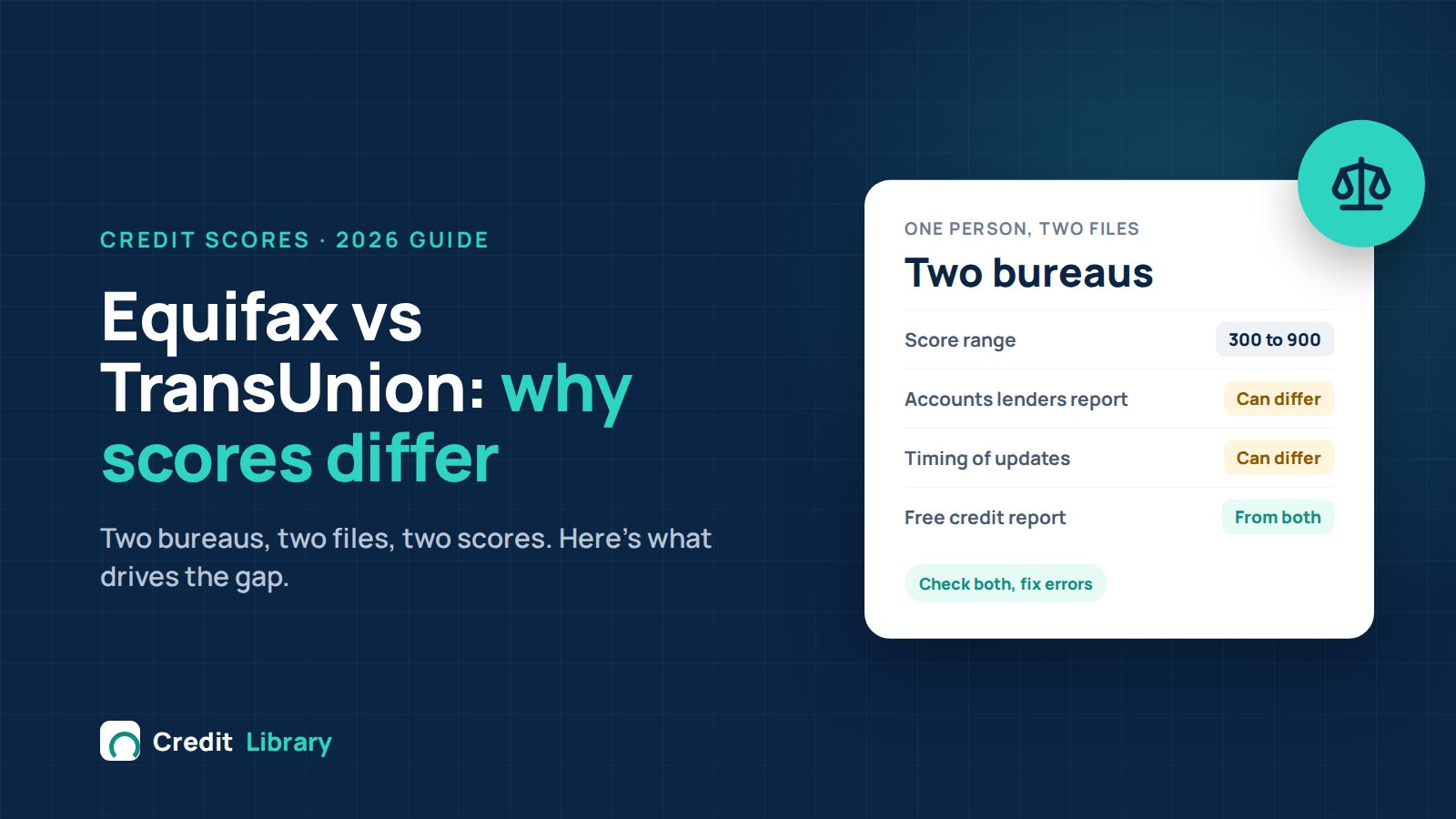
Equifax and TransUnion are Canada’s two main credit bureaus. Your scores differ because not every lender reports to both bureaus, lenders report at different times, and each bureau’s scoring model weighs your information differently. Neither score is the “real” one. Lenders may check either or both, so it’s worth keeping an eye on both reports.
Why your Equifax and TransUnion scores differ
According to Equifax Canada, three main things cause the gap:
- Different data. Lenders aren’t required to report to both bureaus. A card or loan might appear on one report and not the other, or not at all. The same is true for newer data like rent: some services report to one bureau only, such as FrontLobby, which began reporting to TransUnion in January 2026.
- Different timing. Lenders send updates on their own schedules. If your card balance dropped after one bureau’s update but before the other’s, your scores will reflect different balances.
- Different formulas. Each scoring model has the same goal, predicting whether you’ll pay on time, but gives different weight to factors like payment history, utilization and credit age. Some models include information, like mortgage or mobile phone payments, that others don’t.
The Financial Consumer Agency of Canada (FCAC) adds that “credit bureaus and lenders use different formulas to calculate your score, but they don’t share the exact details.”
Educational scores vs lender scores
Even the score in your app may not be the one a lender uses. Free scores are usually built for consumers so you can track your credit over time. Lenders may use a different model, or their own, with the same bureau data.
| Where you see it | Bureau | Score model |
|---|---|---|
| Borrowell | Equifax | Equifax Risk Score 2.0 |
| Credit Karma Canada | TransUnion | TransUnion CreditVision Risk Score |
| FICO Score (lenders) | Equifax or TransUnion data | FICO Score, 300 to 900 |
| Your bank or lender | Varies | Often their own internal model |
Which credit score matters more in Canada?
Both. There’s no single score that all Canadian lenders use, and lenders don’t always say which bureau they check. A mortgage lender, a car dealer and a credit card issuer might each pull a different report or use a different model. That’s why a mistake on either report can cost you.
If you’re preparing for a big application, like a mortgage, ask the lender which bureau they use and check that report first. And remember that a “good” number depends on the lender. Our guide to what counts as a good credit score in Canada explains the ranges.
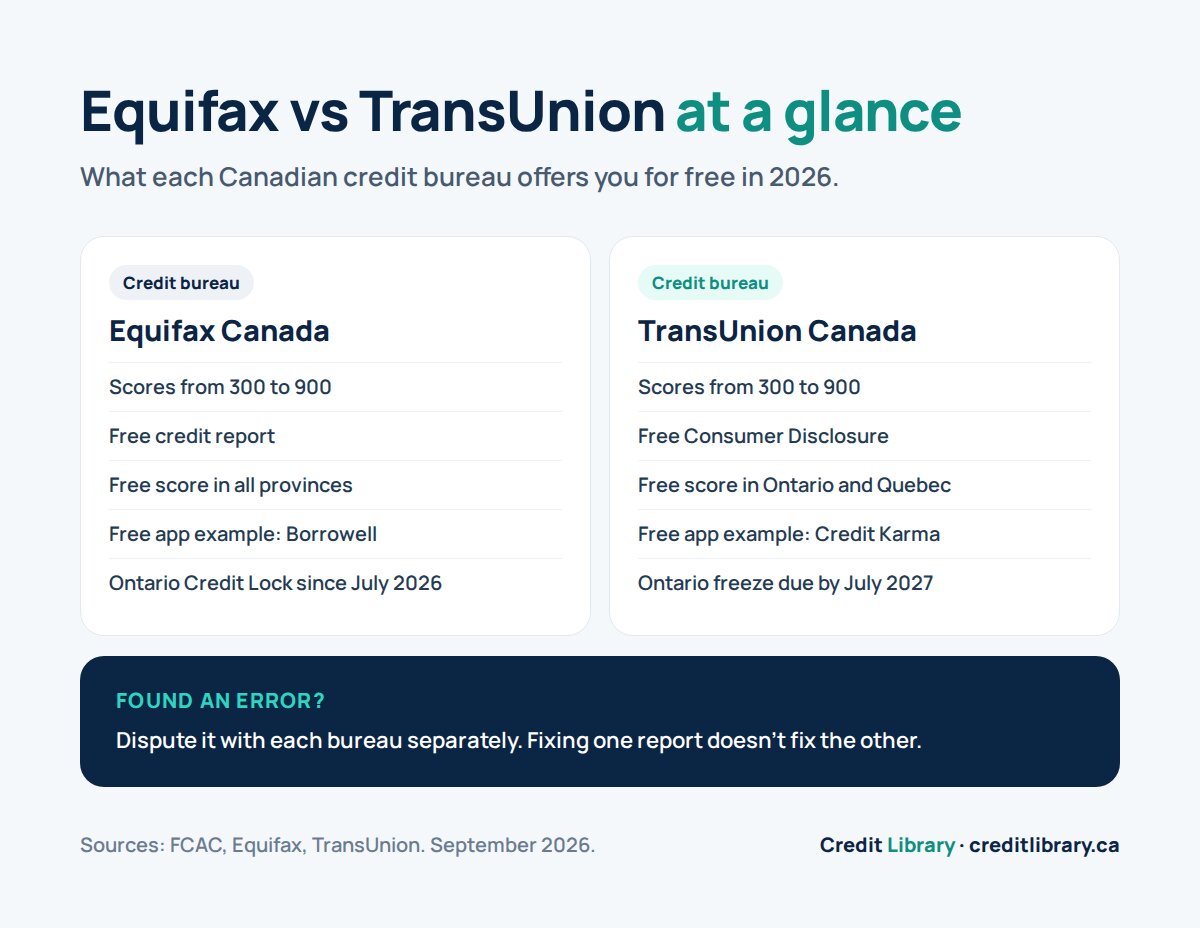
Equifax vs TransUnion: key differences at a glance
| Equifax Canada | TransUnion Canada | |
|---|---|---|
| Score range | 300 to 900 | 300 to 900 |
| Free credit report | Yes, online, by mail or phone | Yes, online, by mail, phone or in person |
| Free credit score | Yes, in all provinces and territories (FCAC) | Included in the free report for Ontario and Quebec residents (TransUnion) |
| Free app example | Borrowell | Credit Karma |
| Credit freeze in Ontario | Credit Lock available since July 1, 2026 | Required by July 1, 2027 |
| Phone | 1-800-465-7166 | 1-800-663-9980 |
How to check both scores for free
Check your Equifax and TransUnion credit for free
Get your Equifax report and score
Request them online, by mail or by phone. The FCAC confirms Equifax offers a free score everywhere in Canada.
Get your TransUnion Consumer Disclosure
TransUnion’s free Consumer Disclosure is available online monthly, by mail, by phone or in person. Ontario and Quebec residents also see their score.
Consider a free app
Borrowell shows an Equifax score and Credit Karma shows a TransUnion score, both updated regularly. These are optional and not the only options; your bank may also show a free score.
Compare the accounts
Look for any card, loan or collection that appears on one report but not the other, and check balances and payment history line by line.
Checking your own credit is a soft inquiry and won’t lower your score. Learn more about hard vs soft credit checks, or follow our step-by-step guide to checking your credit report for free.
What to do if one report has an error
Because the bureaus keep separate files, an error can appear on one and not the other. Fixing it at one bureau doesn’t fix it at the other.
- Start with evidence: statements, receipts or letters that show the mistake.
- File with the bureau showing the error, and check the other report for the same problem.
- Add a consumer statement if an accurate but unfair item stays. It’s free to add, and lenders may consider it.
- Late payment on the report? See how to remove late payments for dispute and goodwill options.
Frequently asked questions
Why is my Equifax score different from my TransUnion score?
Each bureau builds its own file on you, and not every lender reports to both or on the same day. The bureaus also use different scoring models that weigh information differently. A gap of a few points, or even more, is normal and doesn’t mean something is wrong.
Which is more accurate, Equifax or TransUnion?
Neither is more accurate by default. Each is only as accurate as the information lenders send it. The best way to know is to check both reports and dispute anything that’s wrong.
Do Canadian lenders use Equifax or TransUnion?
It depends on the lender and the product. Some check one bureau, some check both, and some use their own scoring models with the bureau data. If you want to know, ask the lender before you apply.
Do Equifax and TransUnion have the same information about me?
Not always. Each bureau keeps its own file, built from what lenders send it. An account, a late payment or a collection can appear on one report and not the other, which is why it’s worth checking both.
How can I check both my Equifax and TransUnion scores for free?
You can get free credit reports from both bureaus online, by mail or by phone. Equifax offers a free score in every province, and TransUnion includes your score in its free report for Ontario and Quebec residents. Free apps like Borrowell (Equifax) and Credit Karma (TransUnion) also show a score.
Does checking my own credit score lower it?
No. Checking your own credit report or score is a soft inquiry and won’t affect your credit. Only applications for new credit usually trigger a hard inquiry.
This article is general information, not financial advice. Credit bureau products, free offers and scoring models change over time; check Equifax, TransUnion and your lender for current details. Last reviewed September 2026.