Payday loans are fast, but they’re one of the most expensive ways to borrow in Canada. The rules changed on January 1, 2025, when Ottawa cut the criminal interest rate to 35% and capped payday loan costs at $14 per $100. So what’s the payday loan interest rate cap in Canada now, and what does a loan really cost?
Many borrowers don’t realize how expensive these loans are. In FCAC research published in 2025, only 25% of respondents recognized that payday loans cost more than a credit card cash advance, and half of payday borrowers had taken out more than one. Here’s how the rules work, what they mean for your credit, and safer options when you’re short on cash.
The short answer
- Payday loans: in provinces that regulate them, lenders can charge no more than $14 per $100 borrowed, including all fees, since January 1, 2025.
- Most other loans: the criminal interest rate is now 35% APR, down from a 60% effective annual rate.
- Your credit: payday loans usually aren’t reported to the credit bureaus, but unpaid ones sent to collections can be.
What changed on January 1, 2025
Two federal changes took effect together. First, the Criminal Code limit dropped to an annual percentage rate (APR) of 35%. It’s now measured as an APR instead of an effective annual rate. Second, new Criminal Interest Rate Regulations set a national ceiling for payday loans: the total cost of borrowing can’t exceed 14% of the amount advanced, which is $14 per $100.
Payday loans can still cost more than 35% APR because of a long-standing exemption in the Criminal Code for provinces with their own payday loan rules. The difference now is that those provinces must cap costs at $14 or less. Before, maximums ranged from $14 in Newfoundland and Labrador to $17 in Manitoba and Saskatchewan. Fees for a dishonoured cheque or payment are capped separately at $20.
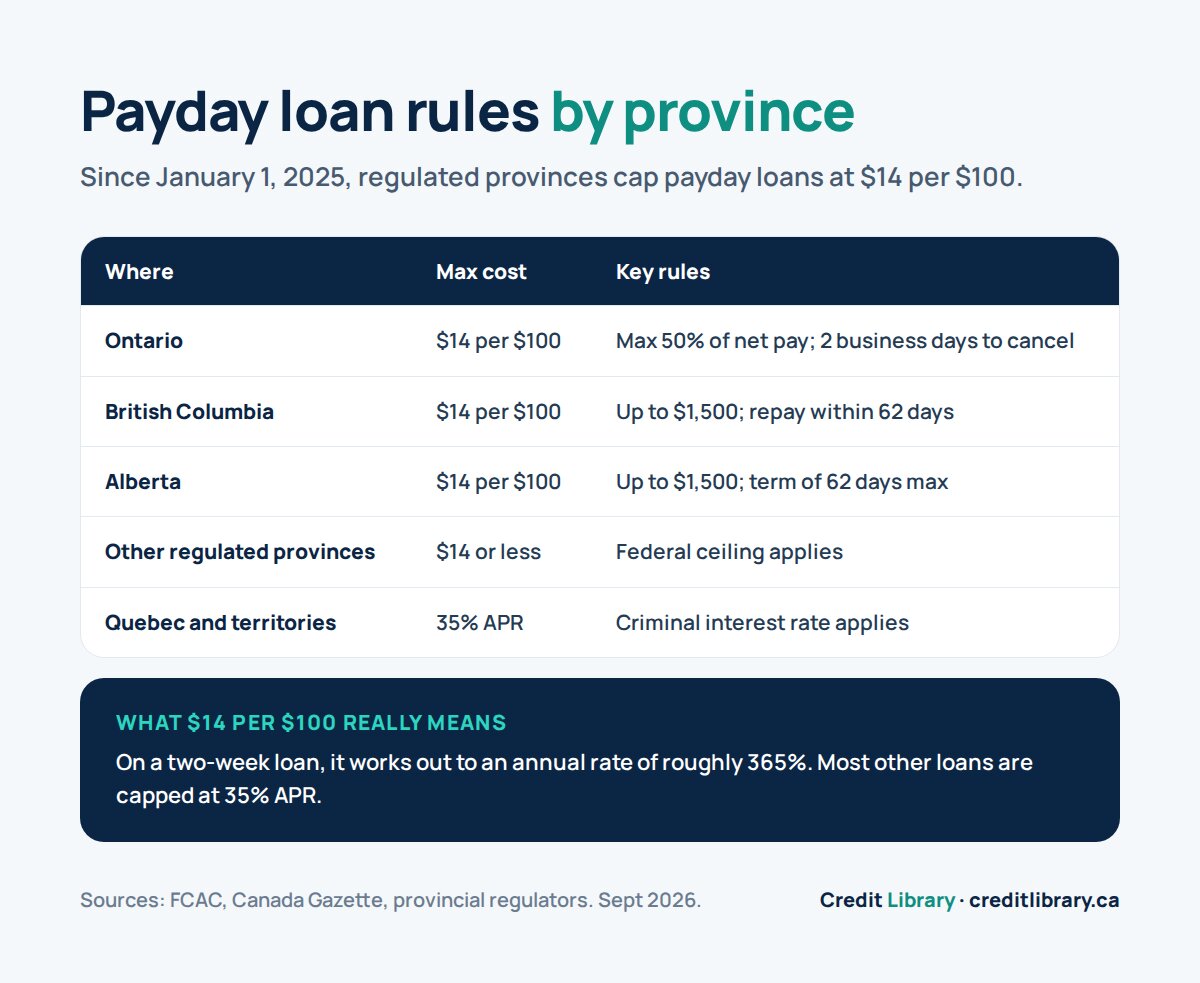
Payday loan rules by province
The FCAC lists nine provinces with payday loan regulations: Alberta, British Columbia, Manitoba, New Brunswick, Newfoundland and Labrador, Nova Scotia, Ontario, Prince Edward Island and Saskatchewan. Everywhere else, payday lenders are held to the 35% criminal rate.
| Province | Maximum cost | Other key rules |
|---|---|---|
| Ontario | $14 per $100 | Loan can’t exceed 50% of your net pay; 2 business days to cancel; no rollovers (Ontario) |
| British Columbia | $14 per $100 | Up to $1,500; must be repaid within 62 days (Consumer Protection BC) |
| Alberta | $14 per $100 | Loans of $1,500 or less; term can’t exceed 62 days (Alberta) |
| Other regulated provinces | $14 per $100 or less | Federal ceiling applies; check your province’s rules |
| Quebec and the territories | 35% APR | No payday loan regulations, so the criminal rate applies (FCAC) |
Ontario adds extra protections: if you take out three loans within 63 days, the lender must offer an extended payment plan so you can repay over several pay periods, and lenders can’t contact you more than three times a week about a missed payment.
The true cost of a payday loan
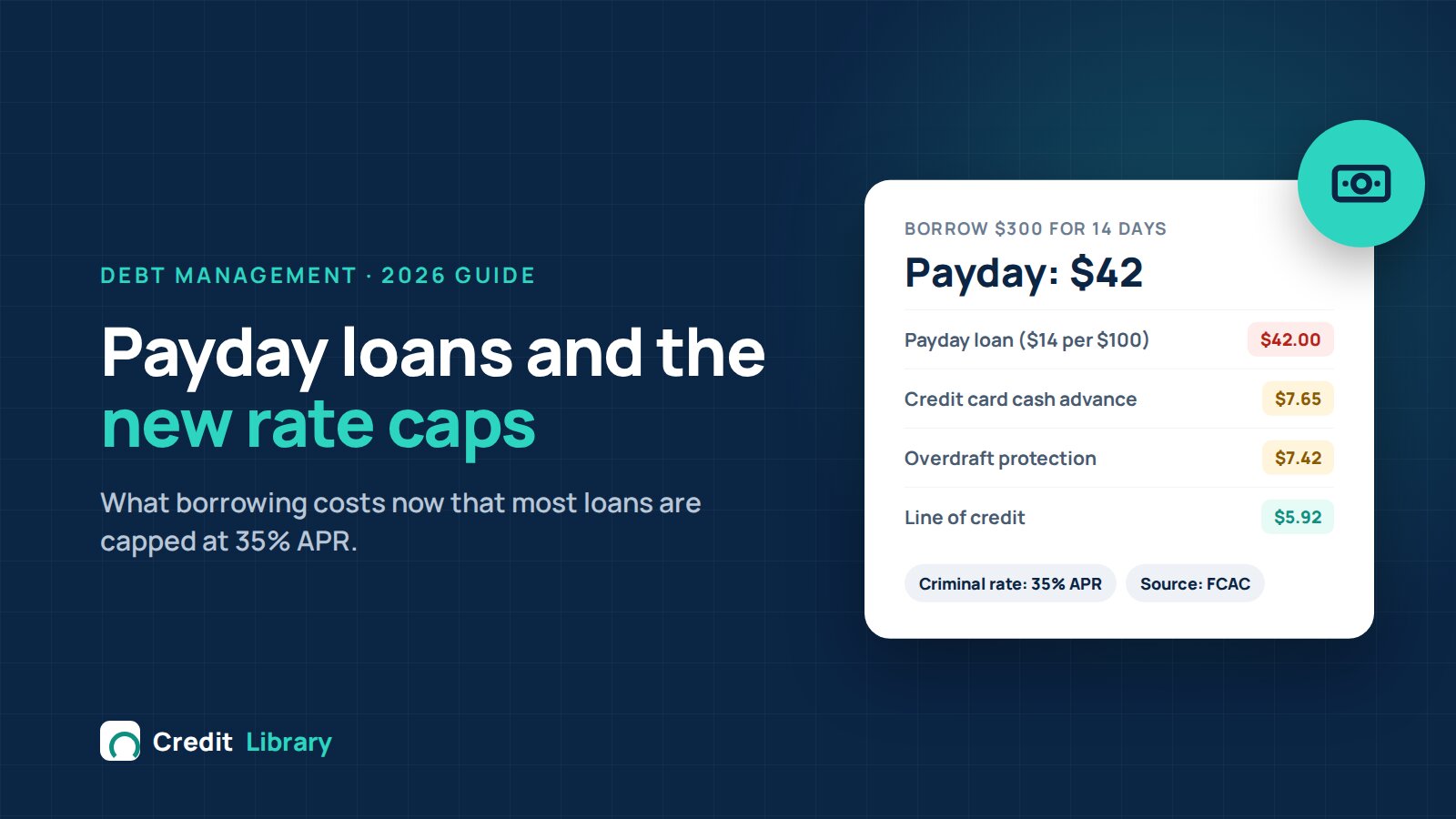
$14 per $100 sounds small, but it’s charged for a loan that usually lasts two weeks. The FCAC’s own example compares borrowing $300 for 14 days:
Cost to borrow $300 for 14 days
Stretched over a year, a $14 fee on a two-week, $100 loan works out to an annual rate of roughly 365%. Compare that with the 35% APR limit that applies to most other lending.
How the debt cycle starts
The real danger is repeat borrowing. You repay the loan on payday, which leaves you short again, so you borrow again. Here’s a simple example at the $14 cap:
- You borrow $500 for two weeks and owe $570.
- Repaying $570 leaves a gap in your budget, so two weeks later you borrow another $500.
- Do that six times over about three months and you’ve paid $420 in fees, and you still need $500.
Those figures come from FCAC’s 2025 payday loan study, which also found that 7% of users repaid a payday loan with another payday loan.
Do payday loans affect your credit score?
Usually not directly. Most payday lenders don’t report your loan or on-time repayments to Equifax or TransUnion, so a payday loan won’t help you build credit. Equifax Canada said in 2024 that it was exploring how payday loan data could affect scores, but that’s research, not standard practice.
The risk runs one way. If you don’t repay, the FCAC warns the lender may use a collection agency, and that collection can appear on your credit report for years. If you want to build credit, a secured credit card does what a payday loan can’t.
Safer alternatives to payday loans
If you need a few hundred dollars before payday, these usually cost far less:
- An employer pay advance. Some employers will advance part of your earned pay at no cost.
- A credit union small loan. Some credit unions offer small-dollar loans built as payday alternatives. Vancity’s Fair & Fast Loan, for example, lends $100 to $2,500 at a fixed 19% rate over one to two years, for members.
- Overdraft protection or a line of credit. Both cost a fraction of a payday loan in the FCAC’s example above.
- Talk to your creditors. Some utilities, landlords and lenders will agree to a short payment arrangement if you ask before the bill is overdue.
- Community and government programs. Local emergency assistance, food banks and provincial hardship programs can free up cash for other bills.
- Free non-profit credit counselling. Members of Credit Counselling Canada can review your budget and options, including debt consolidation or a consumer proposal.
Already in a payday loan cycle? Take these steps
How to break the payday loan cycle
List every loan
Write down each lender, what you owe and the due date so you can see the full picture.
Ask for a payment plan
Contact the lender before the due date. In Ontario, lenders must offer an extended payment plan after three loans in 63 days.
Stop new borrowing
Avoid taking a new payday loan to repay an old one. That’s how fees compound.
Build a tiny buffer
Even $20 a paycheque in a separate savings account can cover the next small shortfall.
Get free advice
A non-profit credit counsellor can help you choose a plan, like the avalanche or snowball method, for your other debts.
Frequently asked questions
What is the maximum a payday lender can charge in Canada?
In the nine provinces that regulate payday loans, the maximum is $14 for every $100 you borrow, including all fees. That cap took effect January 1, 2025. Where there are no payday loan regulations, lenders are limited by the 35% APR criminal interest rate.
What is the criminal interest rate in Canada in 2026?
Since January 1, 2025, it’s a crime to charge more than 35% APR on most loans. Before that, the limit was a 60% effective annual rate. Payday loans in regulated provinces and some commercial and pawn loans are exempt, but payday lenders must follow the $14 per $100 cap instead.
Do payday loans show up on your credit report?
Usually not while you’re repaying them, because most payday lenders don’t report to Equifax or TransUnion. If you don’t repay and the debt is sent to a collection agency, the collection can appear on your credit report and hurt your score.
Can I have two payday loans at once?
In Ontario, the same lender can’t give you a new payday loan until the first one is repaid, and rollovers aren’t allowed. Rules differ by province, but taking loans from several lenders at once is one of the fastest ways into a debt cycle.
How much does a $500 payday loan cost in Canada?
At the maximum of $14 per $100, a $500 payday loan costs up to $70 in fees, so you’d repay $570. If the term is two weeks, that works out to an annual rate of about 365%.
What should I do if I can’t repay a payday loan?
Contact the lender before the due date and ask about an extended payment plan, which Ontario lenders must offer in some cases. Then talk to a non-profit credit counsellor, who can review your whole budget and options for free.
This article is general information, not legal or financial advice. Payday loan rules vary by province and can change; check your provincial consumer protection office and the lender’s licence before you borrow. Last reviewed September 2026.