If you borrowed to pay for school, you’ve probably wondered: how do student loans affect your credit in Canada? Canadians owed about $28.5 billion in federal student loan principal as of July 31, 2025, according to the federal Chief Actuary, and that doesn’t include provincial loans or bank student lines of credit.
A student loan can be a great credit builder, but falling behind carries tougher consequences than most debts. Here’s how it all works in 2026, from the six-month grace period to default and bankruptcy.
The short answer
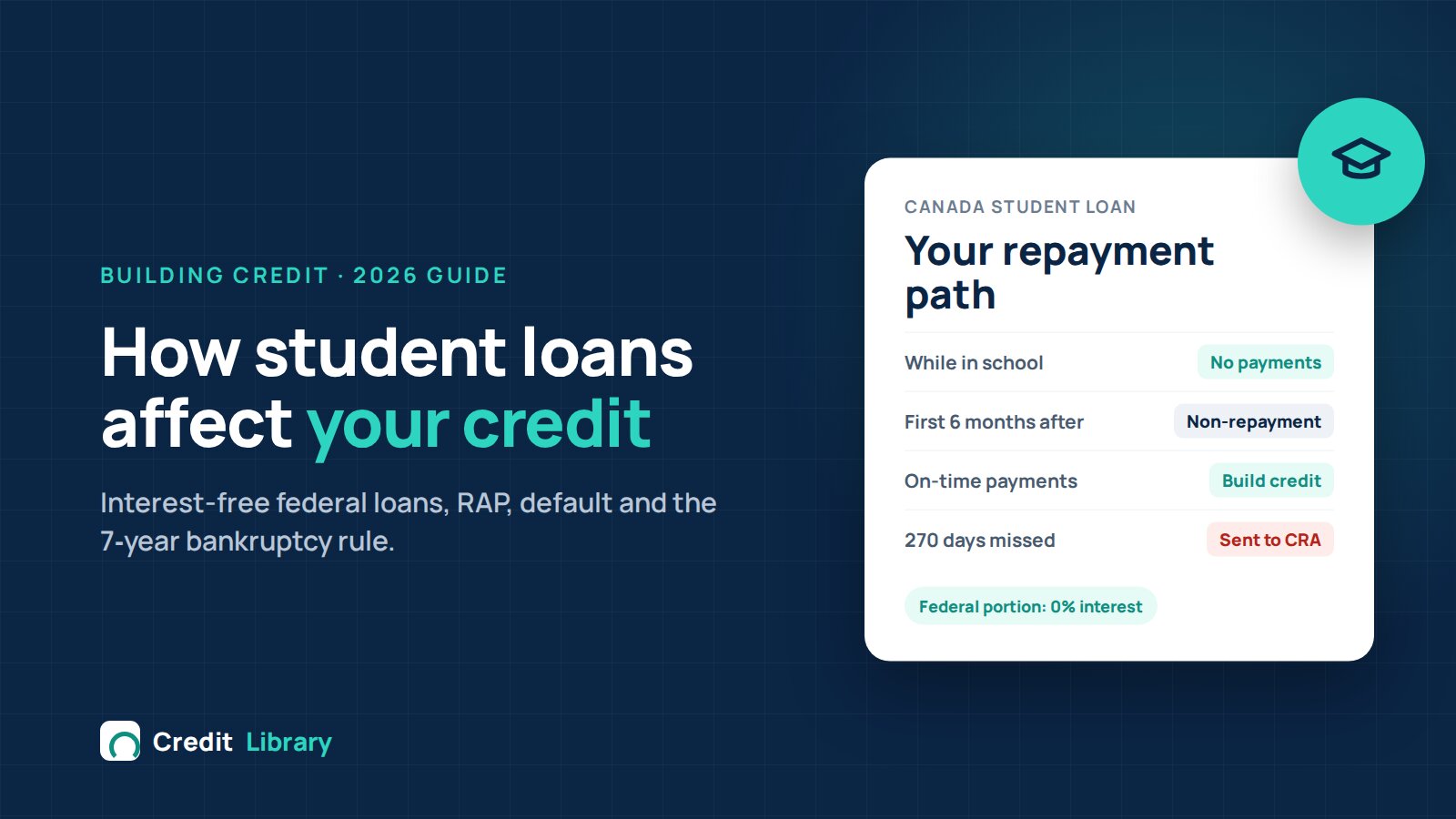
Student loans affect your credit like any other loan. Once your Canada Student Loan is in repayment, it’s reported to the credit bureaus monthly, so every on-time payment adds positive history. Missed payments lower your score, and nine months of missed payments sends the loan to the Canada Revenue Agency (CRA) for collection.
How Canada Student Loans work in 2026
Most provinces issue student aid as a package: a federal Canada Student Loan plus a provincial loan. The federal government permanently eliminated interest on Canada Student Loans and Canada Apprentice Loans on April 1, 2023. Quebec, the Northwest Territories and Nunavut run their own programs instead.
Provincial portions follow their own rules. B.C. student loans stopped accumulating interest on February 19, 2019, while the Ontario portion of OSAP charges prime plus 1%, including during your grace period. In Alberta, Nova Scotia and Prince Edward Island, you repay the provincial loan separately through the province. Check your provincial student aid office for your exact terms.
| Loan type | Interest | Reported to credit bureaus |
|---|---|---|
| Canada Student Loan (federal portion) | None since April 1, 2023 | Yes, monthly once in repayment |
| Provincial student loan | Varies: B.C. 0%, Ontario prime + 1% | Varies by province; missed payments can be reported |
| Bank student line of credit | Variable, usually based on prime | Yes, like other lines of credit |
When do student loans show up on your credit report?
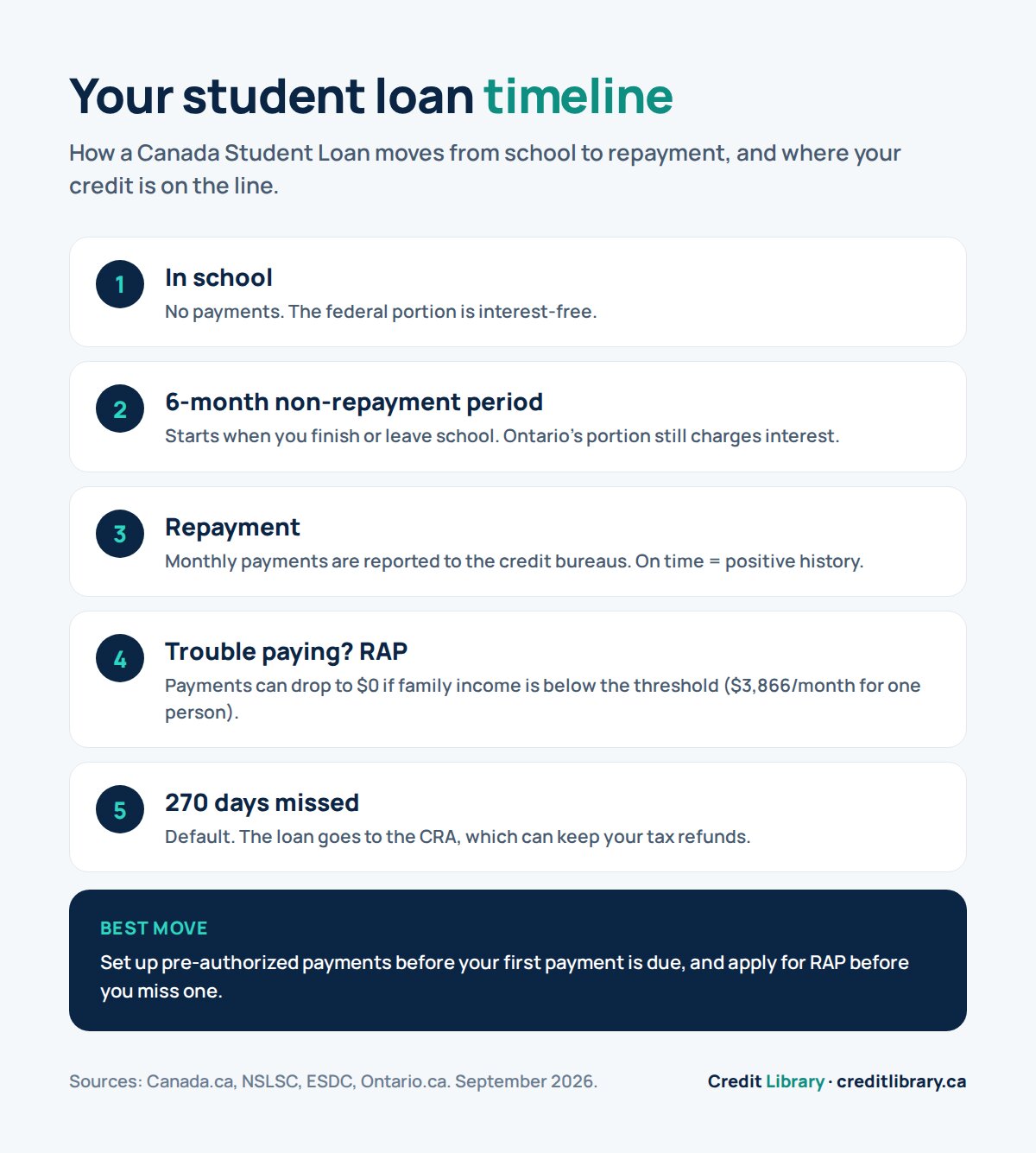
You don’t make payments while you’re in school, and after you finish, there’s a six-month non-repayment period before regular payments begin. According to an Employment and Social Development Canada report to Parliament, Canada Student Loans in repayment are reported to the credit bureaus on a monthly basis.
Getting the loan in the first place usually doesn’t require good credit. Since August 1, 2024, the federal government has permanently eliminated credit screening for first-time applicants aged 22 or older. Bank student lines of credit are different: the bank reviews your application and often asks for a co-signer.
How on-time student loan payments build your credit
Payment history is the biggest factor in your credit score, and a student loan gives you years of it. A student loan is an instalment loan (fixed payments over time), so it also adds variety to your file if your only other account is a credit card. That credit mix can help too.
Paired with one credit card used lightly, it can help you reach a good credit score. Here’s how to set yourself up:
Set up your student loan for on-time payments
Log in to the NSLSC
Create or check your National Student Loans Service Centre account before the six months are up. You’ll get a package with your payment terms within that period.
Find your provincial loan
If you live in Alberta, Nova Scotia or P.E.I., your provincial loan is repaid separately. Set up that one too.
Turn on pre-authorized debit
Automatic payments on payday make missed payments far less likely.
Ask for help early
If payments look unaffordable, apply for the Repayment Assistance Plan before you miss one.
Check your credit reports
Confirm the loan is reported correctly with both bureaus.
Can’t afford the payments? The Repayment Assistance Plan
The Repayment Assistance Plan (RAP) lowers your federal payment based on your family income and size, and your payment can be $0 if your income is low enough. As of the latest Canada.ca update, a single borrower with gross family income under $3,866 a month may not need to make payments, and the threshold for a family of four is $6,412 a month.
- You reapply every six months.
- The government pays any interest your reduced payment doesn’t cover on the federal part of your loan.
- After 60 months on RAP, or 10 years after you finish school, the government starts paying down principal as well.
- Income thresholds may be different for the provincial part of your loan, and P.E.I. borrowers must also apply with the province.
What happens if you default on a student loan
StudentAid BC puts it plainly: missing payments affects your credit rating. Keep missing them and the loan moves into default. According to the NSLSC, if you miss payments for 270 days or more (nine months), your loan is sent to the CRA or your province or territory for collection.
How defaulted federal loans appear on your report has changed over time. A 2022 ESDC report noted that credit bureau reporting historically stopped once a loan moved to the CRA, and that the department was working to report defaulted debts. Either way, the late payments leading up to default are already on your report, and Equifax Canada says late payments can stay on your credit report for up to six years.
You can bring a federal loan back into good standing through rehabilitation: pay off (or capitalize) the outstanding interest and make the equivalent of four monthly payments. For more on collections in general, see debt in collections in Canada.
Student loans in bankruptcy or a consumer proposal
Government student loans get special treatment under the Bankruptcy and Insolvency Act. A bankruptcy discharge releases you from student loans only if you filed at least seven years after you stopped being a full- or part-time student. After at least five years, you can ask a court for early relief if you acted in good faith and face ongoing financial hardship.
Licensed insolvency trustees note the same seven-year rule applies to consumer proposals. Both options also leave their own mark on your credit report. Compare them in consumer proposal vs bankruptcy.
Private student lines of credit
Many students top up government aid with a bank student line of credit. At TD, for example, you make interest-only payments while in school, and no principal payments are due until 24 months after you leave. Terms vary by bank and program, so compare carefully.
- Interest applies. Unlike the federal portion of your student loan, a line of credit charges interest from day one.
- It counts toward your utilization. A line of credit is revolving credit, so a balance near the limit can weigh on your score.
- A co-signer is on the hook too. Undergrads often need one, and missed payments can hurt both of you. See co-signing a loan in Canada.
- It isn’t a government student loan. RAP and the seven-year bankruptcy rule apply to government loans, not bank credit.
Frequently asked questions
Do student loans affect your credit score in Canada?
Yes. Canada Student Loans in repayment are reported to the credit bureaus every month, so on-time payments help your credit history and missed payments hurt it. Private student lines of credit from banks are reported like other lines of credit.
Do student loans show up on your credit report while you’re in school?
Federal records show Canada Student Loans are reported monthly once in repayment, so you may see little activity before then. A bank student line of credit usually appears once it’s opened.
Are Canada Student Loans still interest-free in 2026?
Yes. The federal portion of Canada Student Loans has been permanently interest-free since April 1, 2023. Provincial portions follow provincial rules: B.C. loans are interest-free, while Ontario charges prime plus 1% on its portion.
What happens if I stop paying my student loan?
Missed payments can be reported to the credit bureaus and lower your score. After nine months (270 days) of missed payments, the federal part of your loan goes to the Canada Revenue Agency for collection, which can keep your tax refunds and GST/HST credit and cut off access to future student aid.
Can I get my student loans forgiven in bankruptcy?
Only in limited cases. A bankruptcy discharge releases government student loans if you file at least seven years after you stopped being a full- or part-time student. After five years, you can ask a court for relief if you can show good faith and ongoing financial hardship.
Does paying off my student loan early hurt my credit?
Paying off a loan doesn’t damage your credit. The account is reported as paid and closed, and closed accounts paid as agreed can stay on your Equifax report for up to six years, which keeps showing your good payment history.
This article is general information, not financial or legal advice. Student aid rules differ by province and change over time; check with the NSLSC, your provincial student aid office or a licensed insolvency trustee for your situation. Last reviewed September 2026.