You’ve found a place to live, set up a phone and opened a bank account. Then you apply for a credit card and learn you have no credit score. It’s one of the most common questions newcomers ask: does your credit history transfer to Canada? In most cases, it doesn’t, but you have more options than you might think.
A Statistics Canada study found that 14.8% of immigrant families who had been in Canada for less than two years were “credit invisible,” about double the 7.5% rate among Canadian-born families. The same study found the gap closes within a few years. Here’s how to speed that up, and which new cross-border tools can help you from day one.
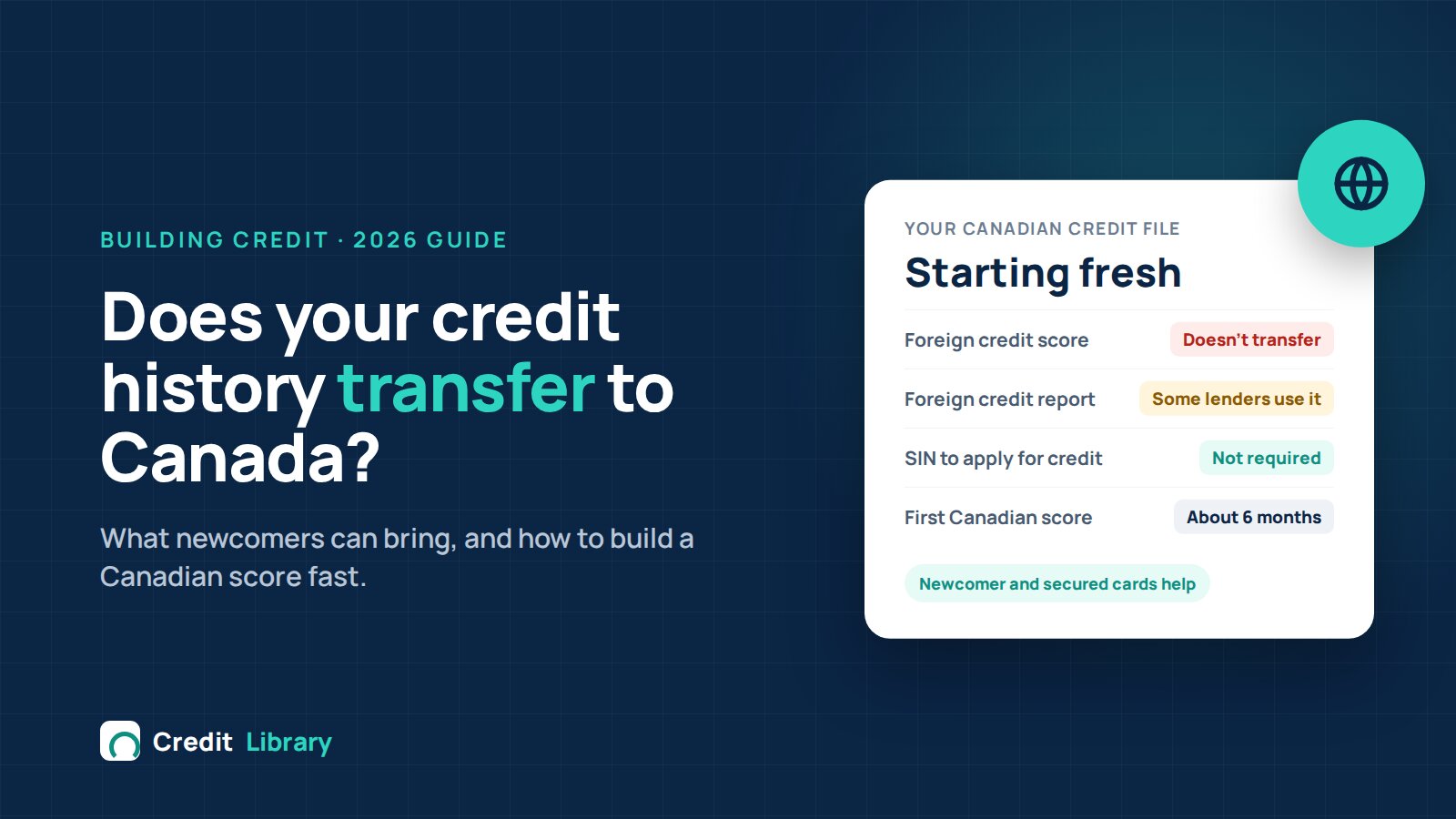
The short answer
Generally, no. Credit history from another country usually does not transfer to Canada, so you’ll start a new file with Equifax and TransUnion. A growing number of lenders can look at your foreign credit report through partnerships like Nova Credit or Equifax’s Global Consumer Credit File, which may help you get approved or get a higher limit. Either way, the fastest path is a newcomer or secured credit card, paid on time, every time.
Why your credit history doesn’t follow you
Credit bureaus are national. Canada’s two bureaus, Equifax Canada and TransUnion Canada, don’t automatically receive data from bureaus in other countries, partly because of privacy laws and different reporting systems. Scoring systems differ too: Canadian scores run from 300 to 900, while many other countries use different ranges or no score at all.
That means a great score back home doesn’t become a great score here. It also means your Canadian file starts with a blank slate, which is better than a bad one.
Ways to use your foreign credit history in Canada
While nothing moves your old score into the Canadian system, a few programs let lenders see your history when you apply:
| Option | How it works | Good to know |
|---|---|---|
| Nova Credit (via Scotiabank) | With your consent, the lender checks your credit report from select countries | Countries listed include India, Mexico, the Philippines, the UK and the US |
| Equifax Global Consumer Credit File | Lets lenders see a calibrated score based on your foreign Equifax data | Launched in October 2024 with India, with more countries planned |
| Amex Global Card Transfer | Existing Amex cardholders from abroad can apply without a Canadian credit report | You need an existing foreign American Express card |
| Bank newcomer programs | Credit cards designed for people new to Canada | For example, RBC advertises limits up to $15,000 with no credit history required |
Two things to keep in mind. First, these tools are lender-driven: a lender has to participate, and Equifax’s program is offered to lenders rather than sold to consumers. Second, eligibility for newcomer products usually depends on how recently you arrived, your status and your income, so ask each lender which countries and applicants they accept.
Do you need a SIN to apply for credit?
You’ll need a Social Insurance Number (SIN) to work in Canada, and banks must ask for it on accounts that pay interest, because that income is reported for tax. But for credit, the Government of Canada’s SIN code of practice is clear: you don’t need to provide your SIN to apply for a credit card, loan, line of credit or mortgage, to get your credit report, or to rent a home.
Start with a Canadian bank account
A bank account won’t build credit on its own, but it’s the foundation for everything else, and many newcomer credit cards come bundled with one. The Financial Consumer Agency of Canada says you can open a bank account even if you don’t have a job or money to deposit right away. You’ll need acceptable ID, such as two documents showing your name, address and date of birth.
How to build Canadian credit from scratch
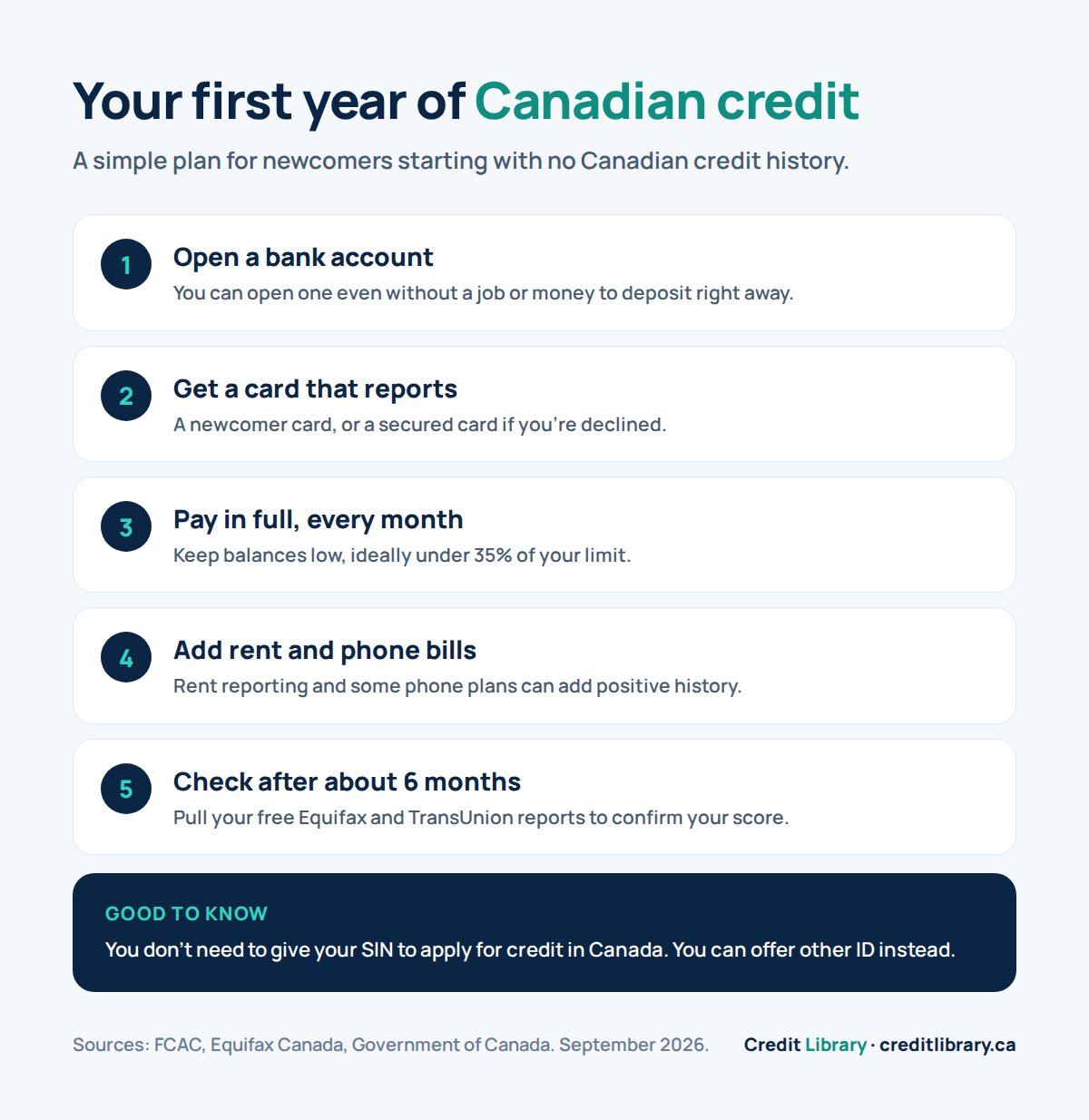
Your credit-building plan as a newcomer
Get a credit card that reports
Apply for a newcomer card, or a secured card if you’re declined. With a secured card, you might put down a deposit, for example $300, which becomes your limit. See our guide to secured credit cards in Canada.
Use it lightly and pay in full
Put a small, regular bill on the card and pay the full balance each month. Equifax suggests keeping balances below 35% of your limit. Learn how credit utilization works.
Report your rent
Rent reporting services can add your on-time rent payments to your credit file. Here’s how rent reporting works in Canada.
Put a phone plan in your name
Equifax notes that some cellphone providers report your payment history to the credit bureaus. Pay every bill on time.
Check your reports
After a few months, pull your free reports from both bureaus to confirm your accounts are showing correctly. Here’s how to check your credit report for free.
How long does it take to build a credit score?
Scoring models need some history before they can produce a number. Many sources, including Wealthsimple, say that’s usually about six months of activity on at least one account. A thin file with one card will get you a score; a strong score takes longer, usually a year or more of on-time payments with low balances.
The Statistics Canada data shows how quickly newcomers catch up. The share of immigrant families with no credit record drops sharply after the first two years:
Share of families that are credit invisible, by time in Canada
One catch: the study found this early visibility came mostly from credit cards, not larger products like mortgages or car loans. Those tend to need a longer track record, so give yourself time before a big application.
Common pitfalls for newcomers
- Applying everywhere at once. Each application usually means a hard inquiry, which can stay on your report for up to 36 months. Apply for one or two products, then wait.
- Maxing out a small limit. A $500 limit with a $450 balance looks risky, even if you pay it off. Pay down the balance before your statement date.
- Missing a phone or utility bill. Unpaid bills can end up in collections, which damages a brand-new file quickly.
- Rushing into a big loan. With no score, car loan offers can come with very high rates. Read what credit score you need for a car loan before you shop.
- Forgetting debts back home. Foreign debts don’t appear on your Canadian report, but you still owe them, and some cross-border tools will show your foreign history to Canadian lenders.
Frequently asked questions
Does my credit score transfer to Canada?
Generally, no. Equifax Canada and TransUnion Canada keep separate files from credit bureaus in other countries, so most newcomers start with no Canadian score. Some lenders can review your foreign credit report through cross-border services, but that usually helps with approval and limits rather than creating a Canadian score.
Do I need a SIN to get a credit card in Canada?
No. According to the Government of Canada’s SIN code of practice, you don’t need to provide your SIN to apply for a credit card, loan, line of credit or mortgage, or to get your credit report. Many lenders ask for it, and you can offer other identification instead.
How long does it take a newcomer to get a credit score in Canada?
It depends on the scoring model, but many sources say you’ll usually need about six months of activity on at least one account before a score is generated. Building a strong score takes longer, often a year or more of on-time payments.
What is the easiest credit card to get as a newcomer?
Many big banks have newcomer credit cards that don’t require Canadian credit history, and secured credit cards are available to almost anyone who can pay the deposit. Both report to the credit bureaus, which is what builds your history.
Can I use my US credit history in Canada?
Not directly, because US and Canadian credit files are separate. But some lenders can check a US credit report through cross-border services, and existing American Express cardholders may be able to apply for a Canadian card through Amex’s Global Card Transfer program.
Does paying my phone bill build credit in Canada?
Sometimes. Equifax Canada notes that some cellphone providers report your payment history to the credit bureaus. Even if yours doesn’t report on-time payments, an unpaid bill sent to collections can hurt your credit, so always pay it on time.
This article is general information, not financial advice. Newcomer programs, eligible countries and lender requirements change often; check with each lender for current details. Last reviewed September 2026.