The Bank of Canada raised its key interest rate on Wednesday, October 28, 2026, with a quarter-point rate hike from 2.25% to 2.5%. It’s the Bank’s first increase since July 2023. Most headlines focus on mortgages. But if you carry credit cards, a line of credit or a HELOC, the decision matters for you too.
So here’s what the rate hike actually changes for your credit cards, your other debts and your credit score, plus what to do about it this week.
Why the Bank of Canada raised rates
The Bank raised its target for the overnight rate from 2.25% to 2.5%, effective October 29. It was the Bank’s first move since it cut rates in October 2025. The goal, it said, is to reduce the risk that high energy prices spread to the prices of other goods and services. With conflict in the Middle East now in its eighth month, oil remains expensive. CPI inflation has been around 3% since April, and the Bank expects it to reach about 3.5% by the end of 2026 before easing back to 2% by mid-2028.
And this may not be the last hike. The Bank said, “There could be a need to increase the policy rate further, but given uncertainties, Governing Council agreed to proceed carefully.” Its next decision is December 9, 2026. So now is a good time to look at which of your debts are exposed.
How a rate hike affects credit cards in Canada
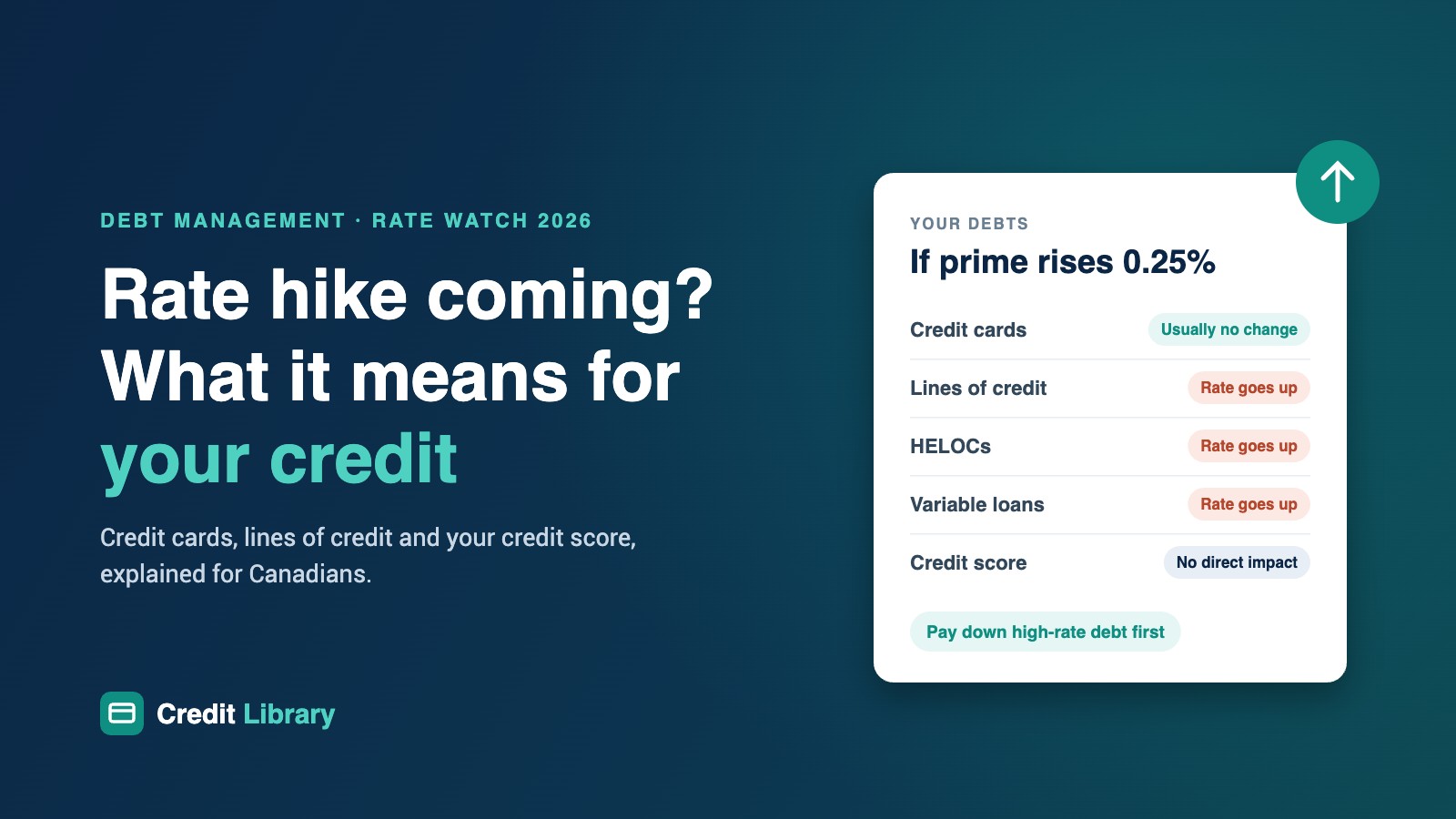
Here’s the good news. Most Canadian credit cards are not tied to the prime rate. Instead, they charge a fixed annual rate, typically around 19.99% to 20.99% on purchases and often higher on cash advances. As a result, the 0.25% Bank of Canada hike likely changes nothing on your card statement.
That’s different from the United States, where most card rates float with prime. In Canada, issuers can still raise your rate, but they must give you written notice first. So read any letters or emails from your card issuer carefully over the next few months.
The debts that do get more expensive
Anything priced at “prime plus” or “prime minus” moves when the Bank of Canada moves. Prime is expected to rise from 4.45% to 4.70% as the big banks match the hike, usually effective the next day. When it does, these rates rise with it:
- Unsecured lines of credit, often priced at prime plus a few percentage points.
- HELOCs, often around prime plus 0.5%.
- Variable-rate mortgages, whether your payment changes or more of it goes to interest.
- Variable-rate personal or car loans, although most car loans in Canada are fixed.
- Some student loans. Federal Canada Student Loans no longer charge interest, but some provincial portions are tied to prime. Check your province’s terms, and see our guide to student loans and credit.
What the 0.25% hike costs, in dollars
| Type of debt | Before the hike | After prime moves to 4.70% | Extra interest per $10,000 |
|---|---|---|---|
| Credit card (fixed) | 20.99% | 20.99% | $0 per month |
| Unsecured line of credit (prime + 3%) | 7.45% | 7.70% | About $2 per month |
| HELOC (prime + 0.5%) | 4.95% | 5.20% | About $2 per month |
| Variable personal loan (prime + 5%) | 9.45% | 9.70% | About $2 per month |
In other words, the hike itself is small. On a $25,000 line of credit, a quarter-point adds only about $5 a month. But the bigger story is how much more expensive card debt is to begin with:
Monthly interest on a $10,000 balance
Does a rate hike affect your credit score?
Not directly. Your credit score is built from your payment history, how much of your available credit you use, the age of your accounts, your credit mix and recent inquiries. Interest rates aren’t part of that formula, so the Bank of Canada can’t lower your score.
However, a rate hike can hurt your score indirectly in three ways:
- Missed payments. If a higher HELOC or mortgage payment squeezes your budget and you fall behind on anything, that late payment can stay on your report for years.
- Higher utilization. If more of your line of credit payment goes to interest, your balance shrinks more slowly. Lines of credit are revolving accounts, so a high balance relative to your limit can weigh on your score. Learn more about credit utilization.
- Leaning on cards. If tighter cash flow pushes everyday spending onto credit cards, your card balances and utilization climb.
Canadians are already carrying record debt
This rate hike lands at a tricky moment. According to TransUnion Canada, consumer debt hit a record $2.64 trillion in the second quarter of 2026. Meanwhile, Equifax Canada reported credit card balances of $134.2 billion.
Lines of credit were also among the fastest-growing debts, with average balances up 7.4% year over year. And the consumer insolvency rate rose to 1.10%. So for many households, even a small increase in borrowing costs adds pressure.
What to do now that rates are up
Your rate hike game plan
List every debt and its rate
Write down each balance, its rate and whether it’s fixed or tied to prime. That shows you exactly what the hike touches.
Attack the highest rate first
Card balances near 20% usually come first. The debt avalanche method saves the most interest.
Consider consolidating card debt
Moving a 20% card balance to a line of credit at 7% to 8% can still cut your interest by more than half. Learn how in our debt consolidation guide.
Automate at least the minimum
Set up automatic minimum payments on every account so a tighter budget never turns into a late payment.
Avoid unnecessary credit applications
Each application can mean a hard inquiry. Space them out, especially if a mortgage renewal is coming. See hard vs soft credit checks.
If you have a mortgage renewal coming up
Your credit score matters more when rates rise, because the best renewal and switch offers go to borrowers with strong credit. Check your reports before you shop, and read our guide to how mortgage renewals affect your credit. For the mortgage side of this decision, our sister site Mortgage Library breaks down what the rate hike means for your mortgage payments.
If you’re already struggling to keep up
Don’t wait for a missed payment. Call your lender early, because many will work with you on a payment plan. And if your debts feel unmanageable, a licensed insolvency trustee can explain options like a consumer proposal, often with a free first consultation.
Frequently asked questions
What is the Bank of Canada’s interest rate now?
The policy rate is 2.5%. The Bank of Canada raised it by 0.25% on October 28, 2026, its first hike since July 2023. The next rate decision is December 9, 2026.
Does a Bank of Canada rate hike affect my credit card interest rate?
Usually not. Most Canadian credit cards charge a fixed rate, typically around 19.99% to 20.99% on purchases, that is not tied to the prime rate. However, your issuer can still change your rate with written notice, so check your cardholder agreement.
Will a rate hike lower my credit score?
No, not directly. Your credit score is based on your payment history, balances, credit age, mix and inquiries, not on interest rates. However, if higher payments lead to missed payments or bigger balances, your score can drop.
Which debts go up when the Bank of Canada raises rates?
Debt tied to prime goes up, usually the next day. That includes unsecured lines of credit, HELOCs, variable-rate mortgages and any variable-rate personal or car loans.
How much more will my line of credit cost after the 0.25% hike?
Once prime rises to 4.70% as expected, about $2 more per month in interest for every $10,000 you owe, or about $21 per month for every $100,000.
Should I consolidate credit card debt now that rates are up?
Moving card debt at about 20% to a line of credit or HELOC at 5% to 8% can still save a lot, even after this hike. But it only works if you stop adding new card balances and have a plan to repay the loan.
This article is general information, not financial advice. Rates and lender terms change, so check your own agreements and speak with a qualified professional about your situation. Last reviewed October 28, 2026.