What is the average credit score in Canada, and how does yours compare for your age and province? According to Borrowell’s 2026 data from more than 4 million members, the average Canadian score is 679, but the number climbs steadily with age, from 659 for Gen Z to 769 for Canadians over 80.
Averages are a useful benchmark, but only if you know where they come from. Here’s what the latest published figures say by age and location, why scores rise as you get older, and how to compare yourself fairly.

The short answer
Based on Borrowell’s 2026 data (which uses the Equifax Risk Score), the average Canadian credit score is 679. Scores rise with age: Gen Z averages 659 and baby boomers 718. By city, Quebec City (723) and Montreal (716) lead, while Edmonton (646) is lowest of the 20 largest cities. A different model, the FICO Score, put Canada’s average at 760 as of April 2024.
Why there’s more than one “average” score
Canada has no single official average credit score. Scores in Canada usually range from 300 to 900, but credit bureaus and lenders use different formulas, and the score you see may not be the one a lender sees. That’s why published averages differ:
- Borrowell (2026): an average of 679, based on the Equifax Risk Score of more than 4 million Borrowell members. It’s the most recent large dataset with age and city breakdowns, but it only covers people who signed up for a free credit monitoring service.
- FICO (April 2024): an average of 760, calculated with the FICO Score from data held by Canada’s two credit bureaus. It’s a different model, so a higher number doesn’t mean Canadians are 80 points better off.
- TransUnion (Q1 2026): doesn’t publish an average score, but reports that 42.2% of Canadian consumers are in its super prime tier, the lowest-risk group.
Average credit score in Canada by age
In Borrowell’s 2026 data, the average climbs with every generation, with the biggest jumps among older Canadians:
Average credit score by generation, 2026
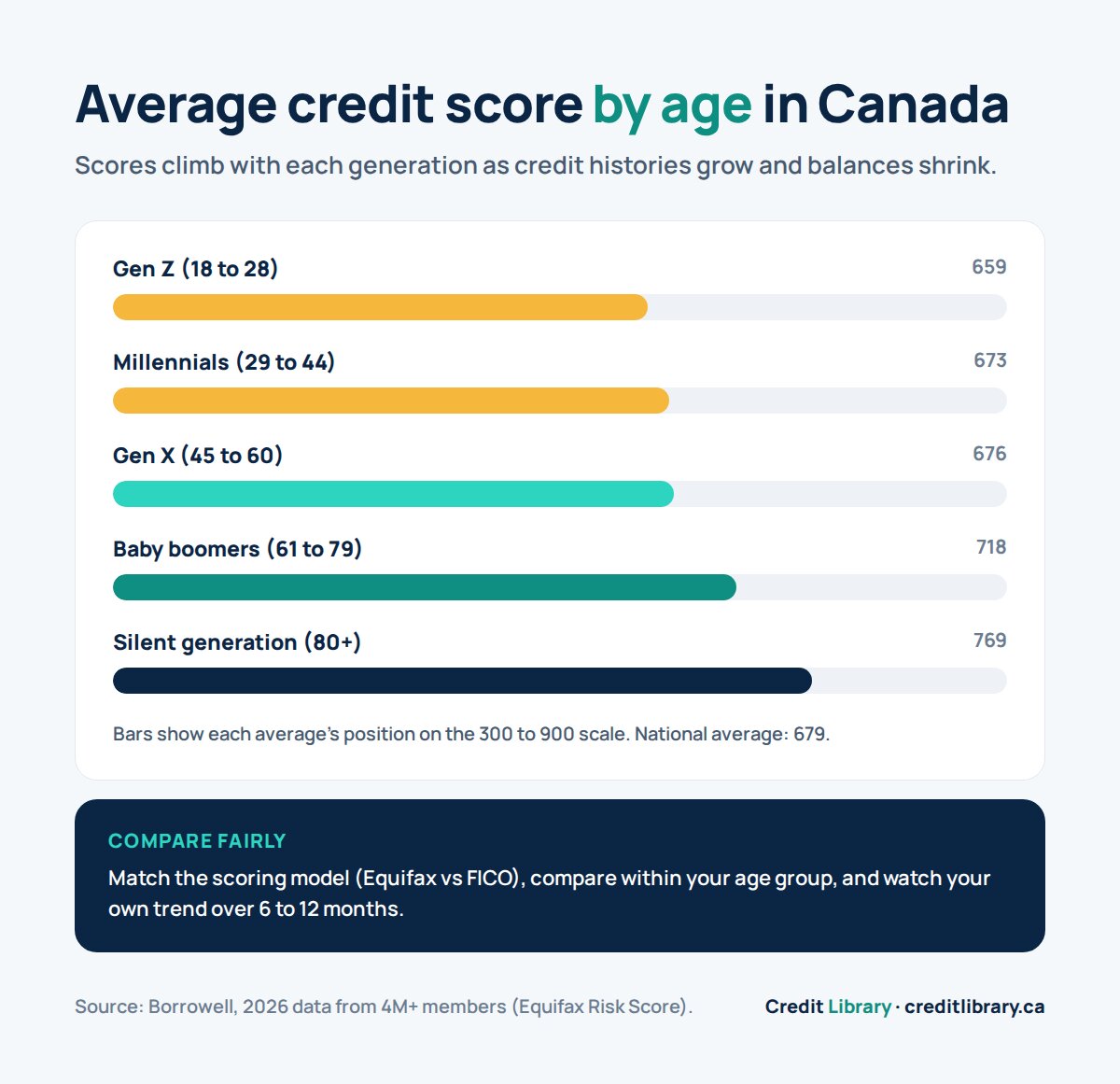
Notice that millennials and Gen X are only three points apart. Those are the years when many Canadians carry a mortgage, car loans and family expenses at the same time, which can keep balances high even when payments are on time.
Why credit scores rise with age
The Financial Consumer Agency of Canada lists the main things that shape your score: payment history, how much of your available credit you use, how long you’ve had credit, the mix of credit you use, and recent credit checks. Time works in your favour on almost all of them:
- Longer history. A 25-year-old may have one or two accounts that are a few years old. A 65-year-old may have accounts that are decades old.
- Lower balances later in life. Many older Canadians have paid down their mortgage and other debts, so they use a smaller share of their available credit.
- Fewer new applications. Young adults open new cards, phone plans and car loans more often, and each application can add a hard inquiry.
- Fewer missed payments. TransUnion’s Q1 2026 data shows the rate of consumers 90 or more days behind falls with each generation, from 2.75% for Gen Z to 0.83% for the silent generation.
Gen Z is also growing fast as a group of borrowers. TransUnion counted more than 460,000 more credit-active Gen Z consumers than a year earlier. Lots of brand-new credit files naturally pull the average down, because a thin file can’t earn a top score yet.
Average credit score by province and city
Neither Equifax nor TransUnion publishes official average scores by province, so treat any provincial figure you see online as an estimate. The best recent data is Borrowell’s 2026 ranking of Canada’s 20 most populous cities:
| Province | Cities in the 2026 data (average score) |
|---|---|
| Quebec | Quebec City 723, Montreal 716, Laval 704, Gatineau 684 |
| Ontario | Markham 714, Vaughan 703, Ottawa 702, Toronto 693, Mississauga 687, Kitchener 678, London 671, Brampton 658, Hamilton 658 |
| British Columbia | Vancouver 704, Surrey 664 |
| Alberta | Calgary 671, Edmonton 646 |
| Nova Scotia | Halifax 669 |
| Saskatchewan | Saskatoon 659 |
| Manitoba | Winnipeg 657 |
A separate dataset points the same way. In TransUnion’s Q1 2026 report, Quebec had the lowest share of consumers 90 or more days behind on a payment (1.36%) and Alberta the highest (2.43%), against a national rate of 1.86%. This measures missed payments, not scores, so it isn’t directly comparable to the city averages, but fewer serious delinquencies generally go hand in hand with higher scores.
Even within a province, averages vary a lot. Markham and Hamilton are both in Ontario but sit 56 points apart. Local incomes, housing costs, the age of the population and the share of newcomers building credit from scratch all play a part.
What counts as a good credit score?
Being above average is nice, but lenders care about where your score falls on their scale, not how you rank against your neighbours. On the common 300 to 900 scale, a score in the high 600s or above is generally considered good, and scores around 760 and up are in the top tier. See what is a good credit score in Canada for the full ranges and what each one means for approvals.
How to compare your score fairly
Benchmarking your own credit score
Check the model
Note whether your score is from Equifax or TransUnion, and which scoring model it uses. Your two bureau scores can differ for normal reasons.
Pick the right average
Compare an Equifax-based score with Equifax-based averages (like Borrowell’s), and within your own age group.
Pull your full reports
Your score is only as good as the data behind it. Get your free credit reports and look for errors or accounts you don’t recognize.
Track your trend
Your own score over 6 to 12 months tells you more than any national average. Rising is good, whatever the starting point.
How to move above the average
If you’re below the average for your age, the same few habits make the biggest difference:
- Pay every bill on time. Payment history is the most important part of your score, and one payment 30 days late can undo months of progress.
- Keep balances low compared to your limits. Here’s how credit utilization works.
- Keep older accounts in good standing open so your history keeps getting longer.
- Space out credit applications and only apply for what you need.
- New to credit or new to Canada? Start with the basics in how to build credit from scratch.
Frequently asked questions
What is the average credit score in Canada in 2026?
It depends on the source. Borrowell’s 2026 data from more than 4 million members puts the average at 679, using the Equifax Risk Score. FICO reported an average FICO Score of 760 for Canada as of April 2024. The two use different scoring models and populations, so they can’t be compared directly.
What is a good credit score for my age in Canada?
Lenders don’t judge you by age, they judge the score itself. A score in the high 600s or above is generally considered good on the 300 to 900 scale. Age averages are useful as context: in Borrowell’s 2026 data, Gen Z averaged 659 and millennials averaged 673.
Which province has the highest average credit score?
Neither Equifax nor TransUnion publishes official average scores by province. In Borrowell’s 2026 city data, Quebec cities ranked highest (Quebec City at 723 and Montreal at 716), and TransUnion’s Q1 2026 data shows Quebec also had the lowest rate of serious delinquency.
Is 700 a good credit score in Canada?
Yes. A 700 falls in the good range on most Canadian scales and is above the 679 average in Borrowell’s 2026 data. Many lenders will approve you for mainstream credit cards and loans at that level, though the best rates usually go to higher scores.
Why is my credit score lower than average?
Common reasons include a short credit history, high balances compared to your limits, recent applications for new credit, or late payments. Check your free Equifax and TransUnion reports for errors first, then focus on paying on time and keeping balances low.
Does checking my own credit score lower it?
No. Checking your own score or report is a soft inquiry and has no effect on your score. Only hard inquiries, which happen when you apply for credit, can lower it slightly.
This article is general information, not financial advice. Published averages come from different sources and scoring models; your lender may use a different score than the one you see. Last reviewed September 2026.