Maybe you’re applying for a mortgage in a few months, shopping for a car, or trying to qualify for a better rate. Either way, the question is the same: how do you raise your credit score fast in Canada? The quickest wins usually come from your credit card balances, and there’s a lot riding on them: Canadians owed $134.2 billion on credit cards in the second quarter of 2026, according to Equifax Canada.
Here’s the realistic version: which moves can show up within a month or two, which ones take longer, what to skip, and a simple 30/60/90-day plan. One promise up front: no one, including us, can guarantee a specific point gain.
The short answer
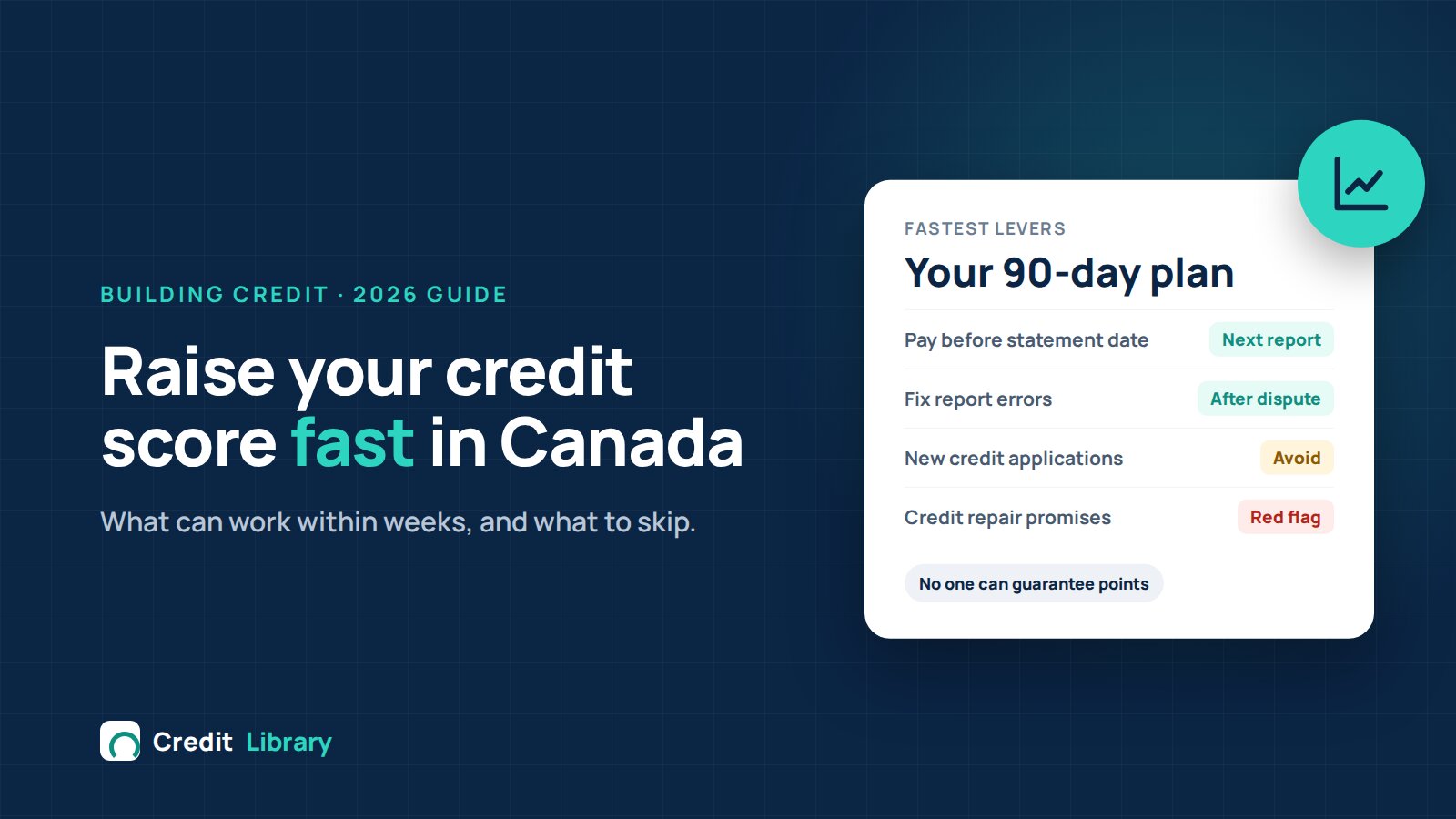
The fastest way to raise your credit score in Canada is to lower the balances your card issuers report, fix any errors on your Equifax and TransUnion reports, and avoid new credit applications. These can show up within one or two reporting cycles. Payment history matters most over time, so automate every payment and keep old accounts open.
How fast can your credit score change?
Your score is calculated from what’s on your credit report, and according to the Financial Consumer Agency of Canada (FCAC), credit bureaus update your report at least once a month. Most card issuers report your balance around your statement date, so a change you make today usually shows up after the next report.
That’s why “fast” in credit terms means weeks to a few months, not days. Negative items take far longer: late payments and collections can stay for up to six years, according to Equifax Canada.
| What you do | When it can show up | Why |
|---|---|---|
| Pay card balances down before the statement date | Often after the next statement | Lower reported balances mean lower utilization |
| Fix an error on your report | After the dispute is resolved | Wrong late payments or accounts are corrected |
| Get a higher credit limit (and don’t use it) | After the next report | Same balance, bigger limit, lower utilization |
| Stop applying for new credit | Gradually | Hard inquiries stay for years but matter less over time |
| Pay every bill on time | Months to years | Builds the history that matters most |
Source for the first two figures: Equifax Canada Q2 2026 consumer credit trends. The 30% guideline comes from the FCAC.
The fastest levers to raise your credit score
1. Pay down card balances before the statement date
Your statement date and your due date are different. The balance on your statement is usually what gets reported, even if you pay it in full a few weeks later. If you pay most of the balance before the statement is generated, a smaller number is reported.
Example: a card with a $3,000 limit and a $2,400 balance is at 80% utilization. Pay $1,800 before the statement date and the reported balance drops to $600, or 20%. The FCAC suggests keeping your balance below 30% of your limit, and lower is often better. Learn more in our guide to credit utilization in Canada.
2. Watch utilization on each card, not just the total
Scoring models can look at both your overall utilization and each card’s. One maxed-out card can hurt even if your total is low. Equifax Canada also suggests making more than one payment a month to keep balances down.
3. Fix errors on both credit reports
A wrong late payment, an account that isn’t yours, or a debt listed twice can drag your score down. Get both reports (here’s how to check your credit report for free), since an error may appear on one bureau and not the other. Dispute anything inaccurate with the bureau and ask the lender to send a correction.
4. Ask for a credit limit increase, carefully
A higher limit lowers your utilization, as long as you don’t spend more. Under federal rules, banks need your express consent each time they raise your limit. Before you ask, find out whether the lender will do a hard credit check. Some do, and a new inquiry right before a mortgage application may not be worth it.
5. Avoid new hard credit checks
Every application for credit usually triggers a hard inquiry. According to the FCAC, inquiries stay on your Equifax report for three years and on your TransUnion report for six. The FCAC recommends applying only when you need credit and, when shopping for a car loan or mortgage, getting quotes within a two-week period. See hard vs soft credit checks for what counts.
6. Set up autopay for at least the minimum
Payment history is one of the biggest parts of your score, and a single payment reported 30 or more days late can undo months of progress. Automate the minimum on every account, then pay extra manually.
7. Keep old accounts open
Equifax Canada lists the average age of your accounts as a scoring factor and suggests not closing paid-off accounts. An old no-fee card also adds to your available credit, which keeps utilization lower.
8. Add rent payments and ask for goodwill
Rent doesn’t appear on most Canadian credit reports by default, but some rent reporting services send it to the bureaus. For example, FrontLobby reports rent to TransUnion Canada. Read does paying rent build credit in Canada before you sign up, since fees and coverage vary.
If you have a single late payment on an otherwise clean record, you can ask the lender for a goodwill adjustment. They don’t have to agree, but it costs nothing to ask. Here’s how to write a goodwill request.
What doesn’t work (and can backfire)
- Paying a credit repair company to “erase” bad credit. Accurate information can’t legally be removed early.
- Closing old or unused cards. It shrinks your available credit and can raise your utilization overnight.
- Opening several new cards at once to boost your limit. The hard inquiries and lower average account age can offset the benefit.
- Expecting a paid collection to disappear. Paying it is still wise, but it generally stays for six years from the date of first delinquency, according to Equifax.
A realistic 30/60/90-day plan
If you have a deadline, like a mortgage pre-approval in three months, here’s a simple sequence. Results depend on your starting point, so treat this as a checklist, not a guarantee.
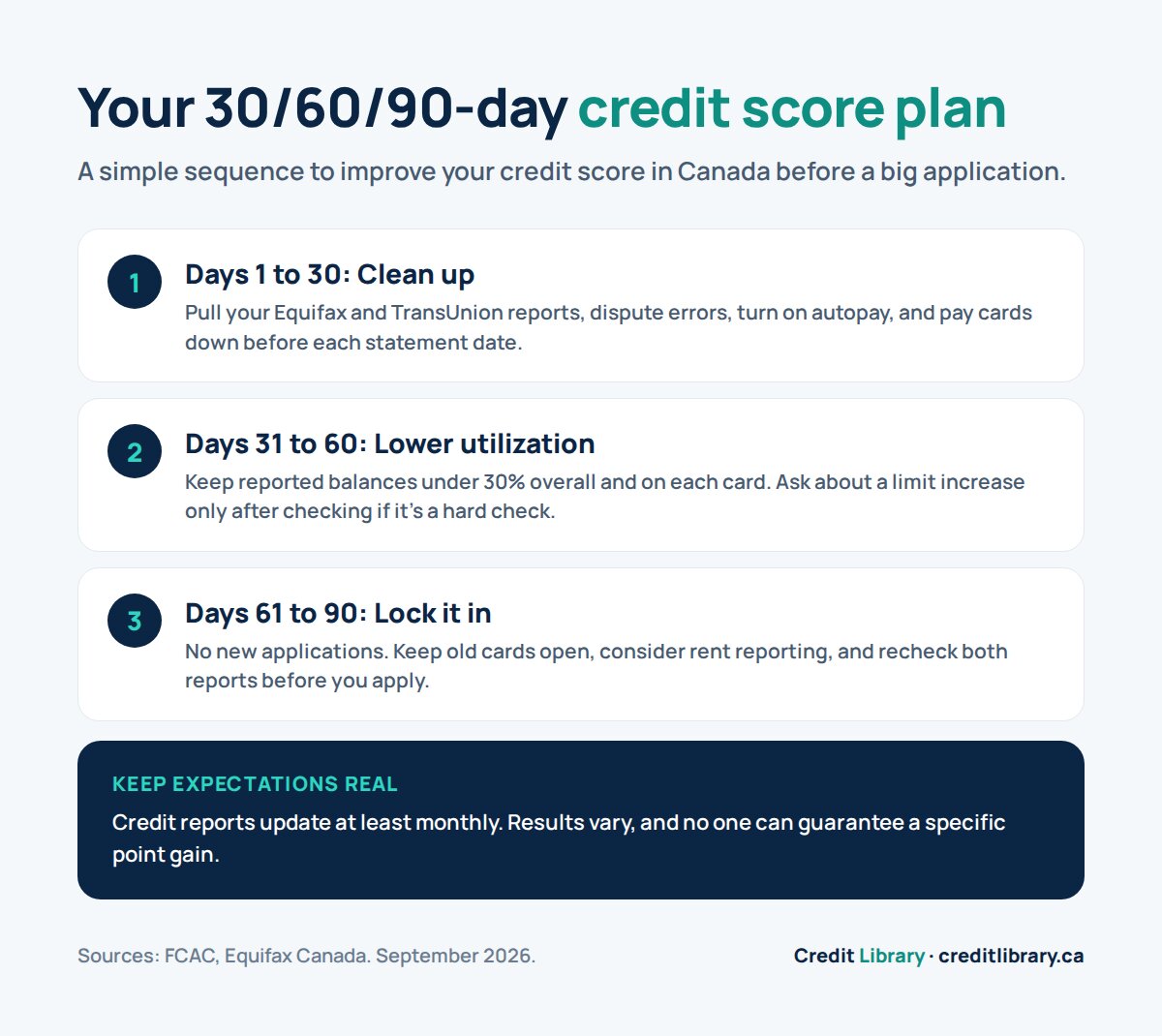
Your 90-day credit score plan
Days 1 to 30: Clean up
Pull both reports and dispute any errors. Turn on autopay for every account. Note each card’s statement date and pay balances down before it.
Days 31 to 60: Lower utilization
Keep reported balances under 30% overall and on each card, ideally lower. If you ask for a limit increase, confirm first whether it involves a hard check.
Days 61 to 90: Lock it in
Don’t apply for new credit. Keep old cards open and active. Consider rent reporting, then check both reports again before you apply for that loan.
If your credit is thin or badly damaged
Fast levers work best when you already have some credit history. If you’re starting from scratch or rebuilding after a consumer proposal, the timeline is longer and the focus is on adding positive history. A secured credit card used lightly and paid on time is a common starting point.
Frequently asked questions
How fast can I raise my credit score in Canada?
Some changes, like paying down credit card balances, can show up after your lenders’ next report to the credit bureaus, which often happens monthly. Bigger problems, like collections or missed payments, take much longer to fade. No one can promise a specific number of points in a specific time.
Can I raise my credit score 100 points in 30 days?
It’s possible in some situations, for example if very high card balances are paid down or a serious error is corrected, but it isn’t typical and no one can guarantee it. Be wary of anyone who promises a set point gain for a fee.
Does paying off a credit card raise your score right away?
Not instantly. Your score changes once the card issuer reports the lower balance to Equifax and TransUnion, which usually happens around your statement date. Paying before the statement date means a lower balance gets reported.
Does checking my own credit score lower it?
No. Checking your own score or report is a soft inquiry and doesn’t affect your score. Hard inquiries happen when you apply for new credit.
Should I pay off a collection account to raise my score?
Paying a collection is usually a good idea, and it updates the account to show it’s paid, but it generally doesn’t remove it. According to Equifax Canada, collections stay for six years from the date of first delinquency, so don’t expect a big overnight jump.
Do credit repair companies work in Canada?
No one can legally remove accurate information from your credit report. Anything a credit repair company does, like disputing errors, you can do yourself for free. In Ontario, credit repair agencies can’t ask you to pay before they start work.
This article is general information, not financial advice. Credit scoring models and lender reporting practices vary; check with Equifax, TransUnion and your lenders for your situation. Last reviewed September 2026.