A family member or friend asks you to sign their loan so they can get approved. It feels like a small favour, but co-signing a loan in Canada makes you legally responsible for someone else’s debt, and it can shape your own credit and borrowing for years.
It’s more common than ever, especially with housing. Equifax Canada data shows joint mortgages made up 70.9% of first-time buyer mortgages through Q2 2026, up from 57.6% in 2016. As Equifax’s Rebecca Oakes put it, “Family support appears to play a larger role in higher-cost markets.” Before you add your name, here’s what co-signing really means.
The short answer
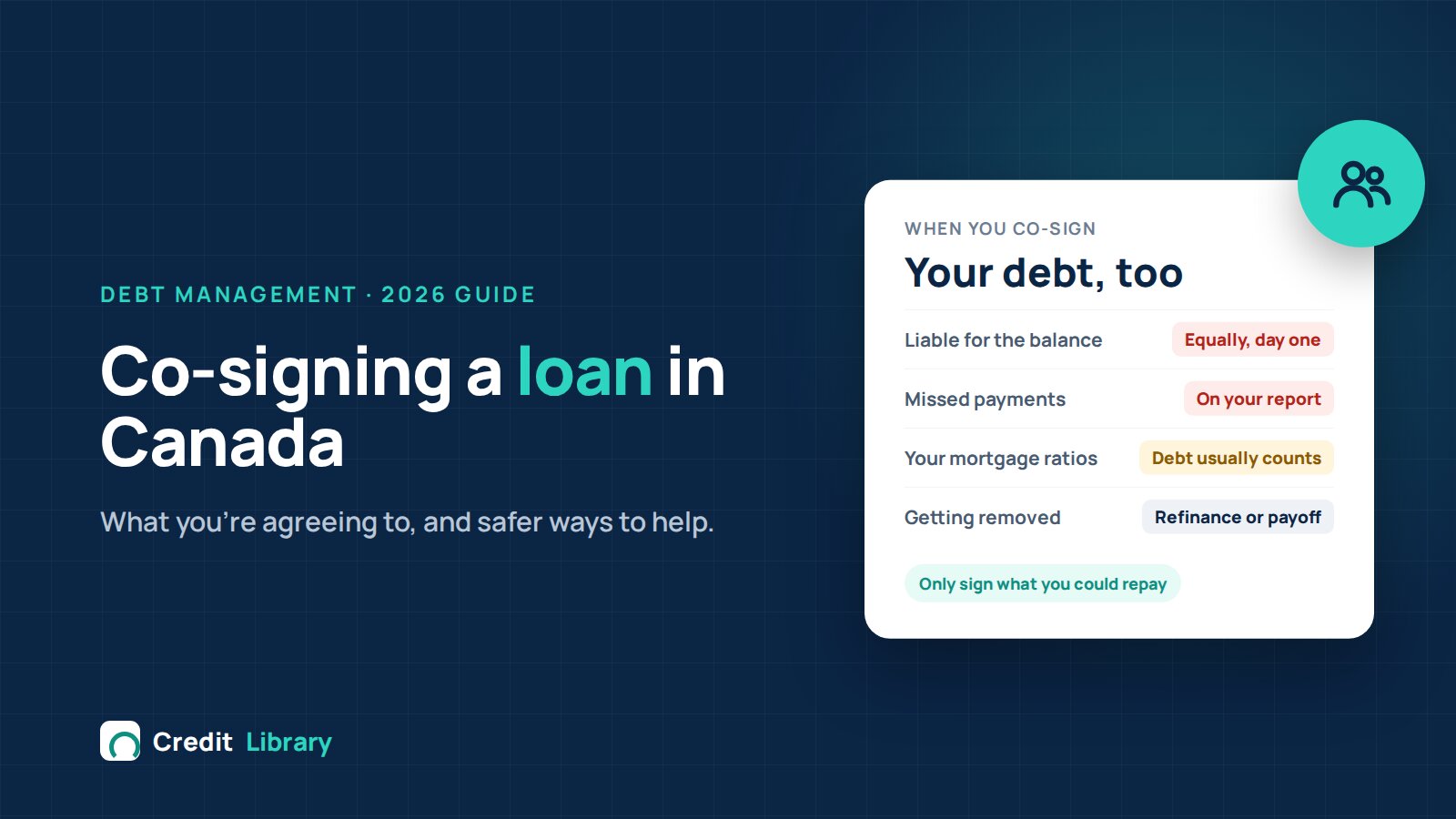
When you co-sign, you’re equally responsible for repaying the loan. If the borrower misses payments, the lender can come to you, and the late payments can land on your credit report. The debt usually counts against you when you apply for your own mortgage or loan, and getting your name off it is hard. A good rule: only co-sign if you could afford to repay the whole thing yourself.
Co-signer vs guarantor vs joint borrower
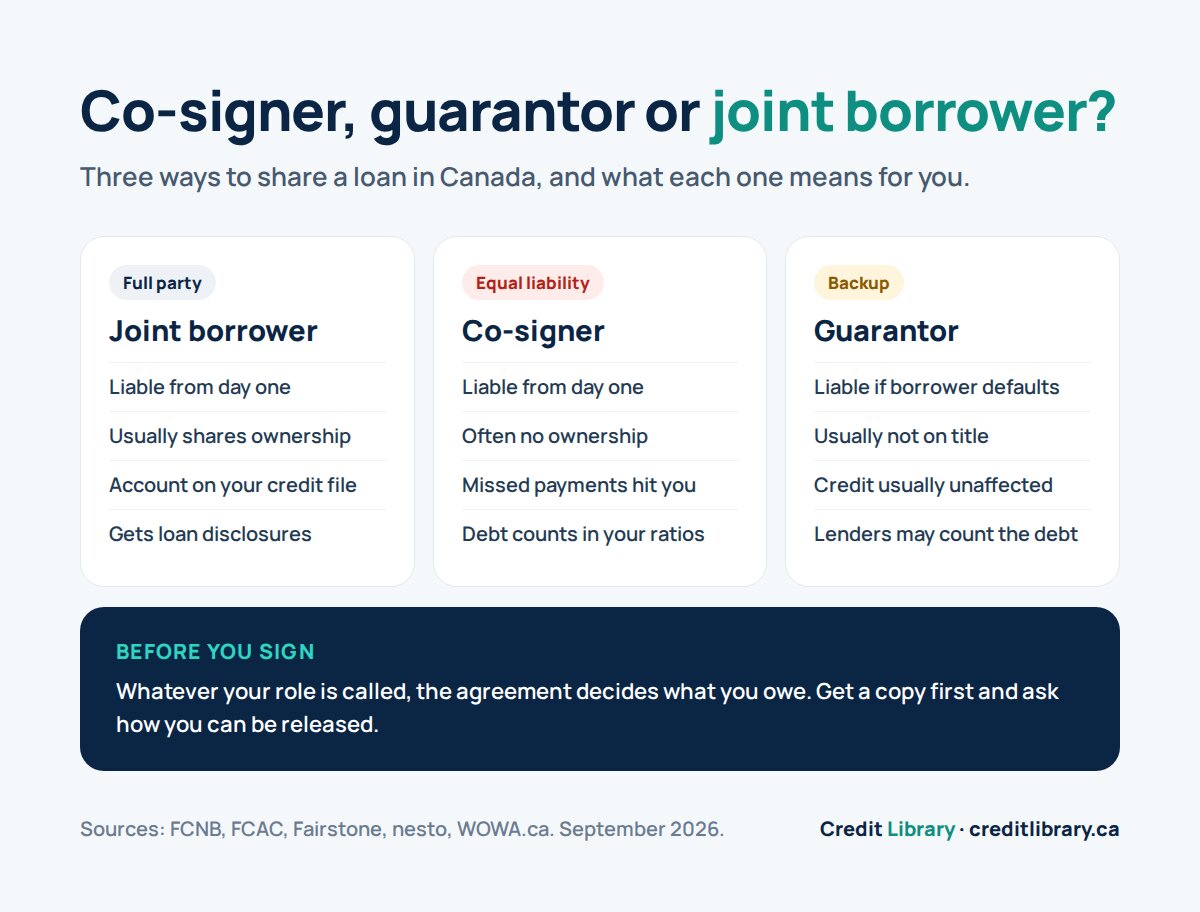
These terms get used loosely, and lenders define them in their own agreements. In general:
| Role | When you’re liable | Ownership | Credit report |
|---|---|---|---|
| Joint borrower | From day one, equally | Usually shares ownership (for example, on title) | Account appears on your file |
| Co-signer | From day one, equally | Often no ownership, though mortgage co-signers are often on title | Account and any missed payments appear |
| Guarantor | If the borrower defaults | Not on title | Usually unaffected unless there’s a default |
The table reflects how lenders such as Fairstone and mortgage lender nesto describe the roles. A joint borrower is a full party to the loan, and the FCAC says every joint borrower with a federally regulated lender has the right to receive cost disclosures and statements. A guarantor steps in only if the borrower doesn’t pay, but can still be pursued for the full amount when that happens.
How co-signing shows up on your credit report
In most cases, a co-signed loan is reported on your credit file as well as the borrower’s. According to the Financial and Consumer Services Commission of New Brunswick, any late payments or defaults by the borrower will be reflected in your credit report and can lower your score.
If the borrower pays on time, the account won’t hurt your score, and it may even add positive history. But you don’t control the payments. And because a co-signer adds their income and credit to the application, the lender will typically review your finances before approving the loan. Check both of your credit reports for free a few times a year so you spot problems early.
How co-signing affects your own mortgage
This is the part many people miss. When you apply for a mortgage, lenders measure your debt service ratios. For insured mortgages, CMHC caps gross debt service (housing costs) at 39% of gross income and total debt service at 44%, and the total includes payments on personal loans, car loans, credit cards and lines of credit.
A co-signed loan generally counts as your debt, even if the other person makes every payment. If you co-sign a mortgage, nesto notes the full mortgage is included in your debt obligations, which can reduce your ability to qualify for your own home or a refinance. Being added to title can also affect eligibility for some first-time homebuyer programs. If you’re planning to buy, read what credit score you need for a mortgage and talk to a lender before you co-sign.
What happens if they miss payments
The FCNB is clear: if the borrower defaults or misses payments, you’re legally obligated to cover them, and you may face collection efforts and legal action. As an equally responsible party, you can be asked to pay as soon as payments are missed. If the debt goes unpaid long enough, it can be sent to a collection agency. Here’s what to know about debt collections in Canada.
If the borrower falls behind
Talk to the borrower right away
Find out if it’s a one-time slip or a bigger problem, and what they can realistically pay.
Call the lender
Ask for the account status and whether a payment arrangement is possible before the account goes 30 days late.
Protect your credit
If you can, make the payment yourself to keep late marks off your report, and keep records.
Plan the exit
Discuss selling the asset, refinancing into the borrower’s name, or paying the loan off.
Can you get removed as a co-signer?
Not easily. The FCNB says it can be challenging to remove your name: usually the borrower has to refinance on their own or pay off the loan. For mortgages, a co-signer or guarantor is typically released only when the borrower can qualify on their own merit, often at renewal. A breakup, a falling out or a verbal promise doesn’t change what you signed.
Questions to ask before you co-sign
- Could I afford every remaining payment myself if I had to?
- Why was the borrower declined on their own, and what’s their plan to qualify alone later?
- Am I a co-signer, guarantor or joint borrower, and will I be on title?
- Will the lender tell me if a payment is missed? Can I get online access to the account?
- How will this debt affect my own plans, like a mortgage, renewal or car loan, in the next few years?
- What’s the exit plan, and when can I be released?
Safer ways to help someone build credit
- A secured credit card. The borrower puts down a deposit, which becomes the limit, and builds history with no one else on the hook. Equifax gives the example of a $300 deposit. See our guide to secured credit cards.
- Adding them as an authorized user. You keep control and can remove them, but you’re responsible for all charges, and not every issuer reports authorized users to the bureaus. Ask the issuer first.
- A gift instead of a signature. Helping with a down payment can reduce the loan size without tying your credit to it. Lenders often have their own rules for gifted down payments.
- Guarantor, with eyes open. A mortgage guarantor isn’t on title, but lenders usually expect good credit and enough income to cover the payments, and many will count the guaranteed debt when you borrow.
- A smaller or shorter loan. If you do co-sign, limit your exposure: a cheaper car, a shorter term, or a lower amount.
If they’re new to credit, point them to our guide on building credit from scratch.
Frequently asked questions
Does co-signing a loan affect my credit score?
It can. The loan usually appears on your credit report, and any late payments or defaults by the borrower will show up there too. If the borrower pays on time, the account itself isn’t harmful, but it still adds to the debt lenders see when you apply for credit.
Can I remove myself as a co-signer in Canada?
Not on your own. You generally stay on the loan until it’s paid off or the borrower refinances into their own name, which requires the lender to approve them without you. For a mortgage, this often happens at renewal if the borrower now qualifies alone.
What is the difference between a co-signer and a guarantor?
A co-signer is equally responsible for the debt from the day the loan starts. A guarantor is usually only called on if the borrower defaults. Both can be pursued for the full balance, so neither role is risk-free.
Will co-signing stop me from getting a mortgage?
It may reduce how much you can borrow. Lenders usually count the co-signed debt when they calculate your debt service ratios, and CMHC caps total debt service at 44% of gross income for insured mortgages. Talk to a lender before you co-sign if you plan to buy soon.
What do lenders look for in a co-signer?
Requirements vary by lender. For mortgages, nesto says lenders typically look for a credit score of 680 or higher, stable income, manageable debt ratios and Canadian residency. For other loans, the point of a co-signer is to strengthen the application, so expect the lender to check your credit and income closely.
Is being an authorized user safer than co-signing?
For the person helping, it can be, because the primary cardholder controls the account and can remove the authorized user. But the primary cardholder is responsible for all charges, and not every card issuer reports authorized users to the credit bureaus, so ask first.
This article is general information, not legal or financial advice. Loan agreements, lender policies and provincial laws vary; read your agreement carefully and consider independent legal advice before co-signing. Last reviewed September 2026.