Need cash fast and thinking about using your card at an ATM? A credit card cash advance is one of the most expensive ways to borrow in Canada. There’s usually a fee, a higher interest rate, and no interest-free grace period, so interest starts the moment you take the money.
With living costs still squeezing budgets in 2026, it’s worth knowing exactly what counts as a cash advance (some transactions will surprise you), what one really costs, how your payments are applied, and what cheaper options you have.
The short answer
A cash advance is when you use your credit card to get cash or something treated like cash. In Canada, you’ll typically pay a fee of a few dollars (or about 1%) per transaction, an interest rate around 22.99% or higher, and interest from day one. It doesn’t directly lower your credit score, but the higher balance can raise your credit utilization.
What counts as a cash advance?
It’s not just ATM withdrawals. According to FCAC and card issuers like RBC and Scotiabank, these are commonly treated as cash advances or cash-like transactions:
- Cash withdrawals at an ATM or bank teller using your credit card.
- Transfers from your card to a bank account, such as moving money into your chequing or savings.
- Convenience cheques (credit card cheques). Interest runs from the date you use the cheque.
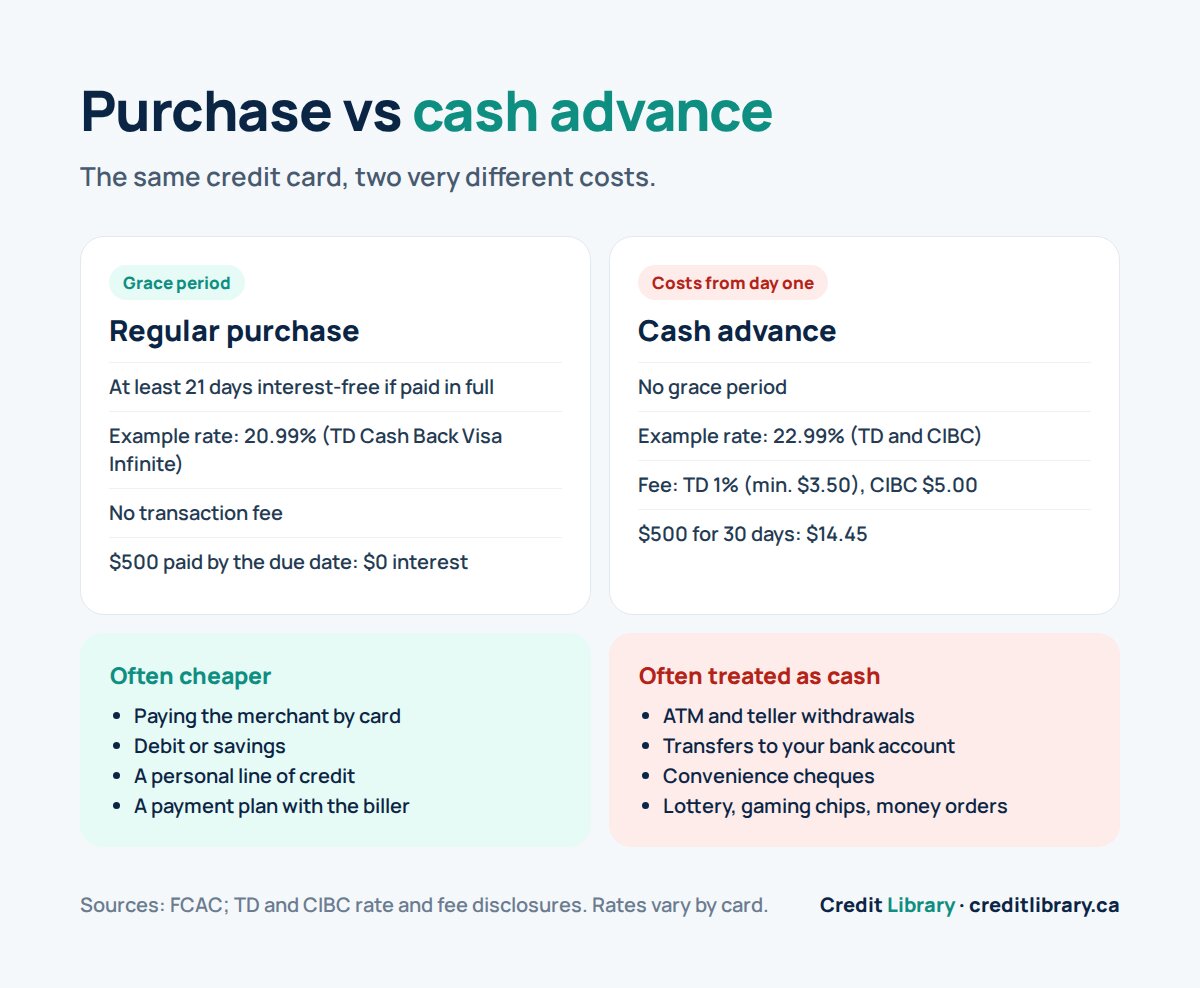
- Cash-like purchases: wire transfers, money orders, travellers’ cheques, foreign currency, lottery tickets, gaming chips and bets, and virtual currencies.
- Some bill payments. RBC notes that paying bills with your card can be treated as cash-like, and suggests setting them up as pre-authorized charges with the merchant instead.
- Balance transfers are a separate category, but on many cards they carry the same rate as cash advances and also have no grace period, unless you have a promotional offer.
How much does a cash advance cost?
There are two costs: a transaction fee and interest. Here’s how two common big-bank cards compare with regular purchases:
| Regular purchase | Cash advance | |
|---|---|---|
| Interest rate | 20.99% (TD Cash Back Visa Infinite); 21.99% (standard CIBC cards) | 22.99% on both |
| Grace period | At least 21 days if you pay your balance in full | None; interest starts right away |
| Fee in Canada | None | TD: 1% (min. $3.50, max. $10.00). CIBC: $5.00 |
| Fee outside Canada | None (foreign exchange fees may apply) | TD: $5.00. CIBC: $7.50 |
Rates and fees vary by card, and some are higher. RBC says cash advance rates at major Canadian banks typically run from 22.99% to 27.99%, and describes typical fees as 3% to 5% of the amount or a $5 to $10 minimum. ATM operators may also charge their own fee on top.
A worked example: $500 from an ATM
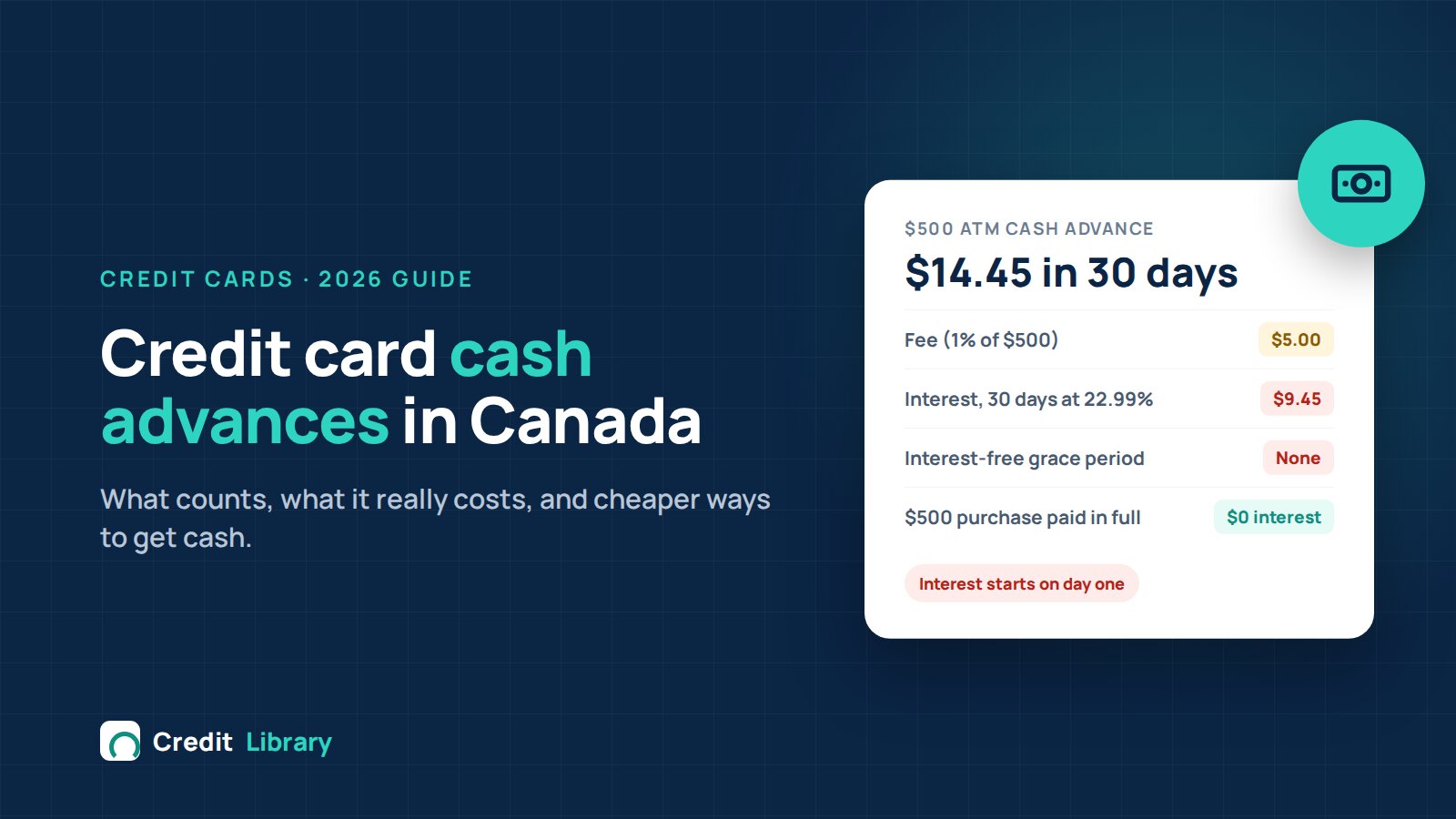
Say you withdraw $500 from an ATM in Canada with a card that charges a 1% cash advance fee and 22.99% interest, and you pay it back in full after 30 days. Using a simple daily interest calculation (22.99% ÷ 365 days):
- Fee: $500 × 1% = $5.00.
- Interest: $500 × 22.99% × 30 ÷ 365 = $9.45.
- Total: $14.45, or about 2.9% of what you borrowed, for a single month.
- If it takes 90 days to repay: $500 × 22.99% × 90 ÷ 365 = $28.34 in interest, or $33.34 with the fee, and more once interest starts being charged on unpaid interest.
- The same $500 as a purchase, paid in full by the due date: $0 in interest.
How your payments are applied
This is where cash advances get sneaky. If your card has a purchase balance and a cash advance balance at different rates, FCAC explains that your minimum payment typically goes to the portion with the lowest interest rate. Any amount you pay above the minimum is applied in one of two ways, depending on your issuer:
- to the portion of the balance with the highest interest rate, or
- proportionally across your entire balance.
So if you only make minimum payments, the higher-rate cash advance can sit there collecting interest while your cheaper purchase balance gets paid down first. Paying well above the minimum, or the full balance, is the only way to clear it quickly. Here’s more on how minimum payments work in Canada.
Does a cash advance affect your credit score?
A cash advance isn’t a separate strike on your credit score. As Scotiabank notes, the impact comes indirectly: it adds to your card balance, which increases your credit utilization. A $500 advance on a card with a $2,000 limit uses 25% of that limit on its own.
The bigger risk is what happens next. Because interest starts immediately and payments may go to cheaper balances first, a cash advance can snowball. If it leads to missed payments, that will hurt your score far more than the utilization bump.
Cheaper alternatives to a cash advance
Depending on your situation, these options are often less expensive. Compare the rates and fees before you choose:
Before you take a cash advance, try these
Pay with the card directly
If the merchant accepts credit cards, a regular purchase gets a grace period. Paying the full balance by the due date means no interest.
Use your own money first
Your debit card or savings avoid fees and interest entirely. Even a small emergency fund helps.
Ask for more time
Some billers and landlords will agree to a short payment arrangement if you ask before the due date.
Consider a line of credit or overdraft
Scotiabank suggests a line of credit, personal loan or overdraft protection as alternatives. Overdraft protection has fees and interest too, so compare the total cost.
Avoid payday loans
They’re usually even more expensive. See how payday loans and Canada’s interest rate cap work.
If you already have a cash advance balance, pay more than the minimum and target it first where you can. The debt avalanche method focuses on the highest-rate debt, and the credit card payoff calculator shows how extra payments shorten the timeline.
Frequently asked questions
How much does a credit card cash advance cost in Canada?
You usually pay a fee plus interest from the day you take the cash. For example, CIBC charges $5.00 per cash advance in Canada, and the TD Cash Back Visa Infinite charges 1% (minimum $3.50, maximum $10.00). Cash advance interest rates on both are 22.99% on standard cards, and ATM operators may add their own fee.
Is there a grace period on cash advances?
No. The minimum 21-day interest-free grace period that federally regulated issuers must give on new purchases doesn’t apply to cash advances, cash-like transactions or balance transfers. Interest starts the day the transaction is made.
Does a cash advance hurt your credit score?
Not directly. A cash advance is added to your card balance, so it raises your credit utilization, which can lower your score until you pay it down. Missing payments because of a growing balance would hurt your score much more.
Is an e-transfer from a credit card a cash advance?
Moving money from your credit card to your chequing or savings account is treated as a cash advance, whatever method you use. Paying bills directly with your card through online banking can also be treated as cash-like, so check your cardholder agreement first.
Is buying lottery tickets or crypto with a credit card a cash advance?
Often, yes. Gaming transactions, lottery tickets, casino chips, money orders, wire transfers and foreign or virtual currencies are commonly treated as cash-like transactions, which means cash advance rates and fees and no grace period.
How do I pay off a cash advance faster?
Pay more than the minimum. The minimum payment typically goes to your lowest-rate balance, while anything above it goes either to your highest-rate balance or is split proportionally, depending on your issuer. Paying the full statement balance clears everything.
This article is general information, not financial advice. Rates, fees and what counts as a cash advance vary by card and can change; check your cardholder agreement and your issuer’s rate and fee summary. Last reviewed September 2026.